
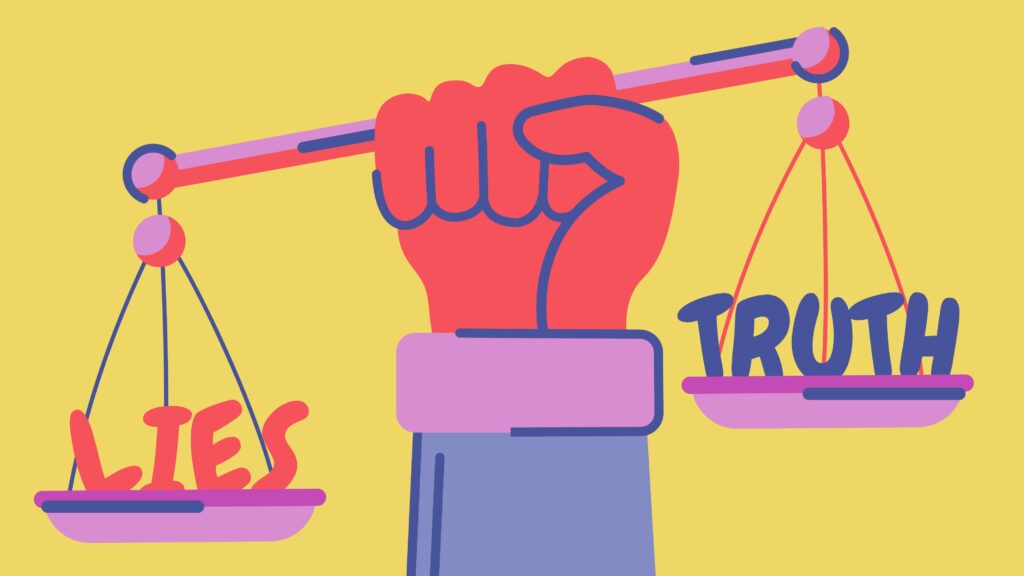
Should you tell a harsh truth if it will only cause pain? Or is it sometimes kinder to keep someone in the dark? Psychologist Emma Levine explores the unwritten rules that guide when people feel it’s acceptable to lie — and what those choices reveal about trust, harm, and our deepest moral values.
Illustration by Masantocreative for Unsplash+
Transcript
The transcript below may be for an earlier version of this episode. Our transcripts are provided by various partners and may contain errors or deviate slightly from the audio.
Shankar Vedantam: This is Hidden Brain, I'm Shankar Vedantam. As we go through our lives, we can all be forgiven for feeling some whiplash. We are told over and over, from the time we are small kids, to always tell the truth. But right from childhood, we are also instructed to tell strategic lies. Tell grandma you like the Christmas present she gave you, or don't tell your sister that you got an extra share of Halloween candy. As we grow up, our lies multiply. We don't tell our co-worker she has a weird laugh. We tell our partners they look amazing even when they don't. We praise our party hosts for delicious dinners even when we felt like throwing up the soup. All the while, we stick to the official message, honesty is the best policy. In our companion episode, we explored the many scenarios where honest people endorse deception. It's titled When It's Okay to Lie. If you haven't listened to it yet, I recommend you start there. This conversation will include references to those ideas. At the University of Chicago, psychologist Emma Levine proposes a new compact of honesty. What happens, she asks, if we were to tell the truth about our lying ways? Emma Levine, welcome to Hidden Brain.Emma Levine:Thank you so much. Great to be here.Shankar Vedantam: Emma, when you were pregnant, you went to your doctor for a routine checkup. Something happened during one ultrasound. What happened?Emma Levine:I was 40 weeks pregnant. I went in for a routine ultrasound to see if the level of amniotic fluid was safe to keep my pregnancy going. And they're just kind of looking around. And suddenly, it just gets kind of quiet in the room. It's me, my husband, and the ultrasound technician. She doesn't say anything. She perseverates on a spot in the ultrasound imaging for a while. Eventually, I say, is everything okay? And she says, your doctor will talk to you in a little while.Shankar Vedantam: I mean, a chill must have gone down your spine, Emma. It did. Yes. And then the tears came too. So your doctor walks in. What does your doctor tell you?Emma Levine:Doctor tells us that there is fluid in my son's kidneys. And they don't know exactly what that means for his health and how bad things will be. But his kidneys have not formed properly. And he will probably need surgery at the very least when he's born.Shankar Vedantam: And what happened subsequently?Emma Levine:Well, it's still ongoing, but he had surgery at 11 days old. And then again, at two and a half years old. And he doesn't have perfect kidney functioning, but he has healthy enough kidney functioning. And he's a wonderful, thriving eight-year-old boy now.Shankar Vedantam: I'm wondering when you went back and thought about what happened in the room, why do you think the tech didn't tell you what the tech was seeing?Emma Levine:Well, I think part of it is legal issues. They're not authorized to be the one who delivers that information as the tech and not your physician. And so part of that is just necessary. But I think it also taps in to something broader. And I think she might have done that even if she were legally allowed to give me information, which is we often think it's better to stay silent, particularly under uncertainty, rather than tell the truth as we know it at that point, or provide potentially any false hope. So as I look back and think about it through the lens of my research, I think that's what she was navigating. Or what one is often navigating, right? Do you say everything looks fine when you think it probably doesn't? Do you give them potentially uncertain, inaccurate, scary information that I think this isn't right, but I don't know everything? Or do you say nothing? And a lot of the time, they say nothing. And for listeners, that's not the best compromise.Shankar Vedantam: What do you think your tech could have told you, given the constraints? I mean, it's possible that maybe in the past, she had said something, and maybe what she had said turned out to be wrong. Maybe the doctor came in and contradicted her, or maybe she wasn't legally authorized to provide the information. So she might have gotten into hot water in the past for opening her mouth. What do you think she could have said at that point that would have been both true and reassuring?Emma Levine:Well, I think she could say, as far as I can tell, the kidney in particular does not look as it is expected, but you are with a very trusted physician who will be able to interpret this information more and give you next steps. Just some sense of what's going on. I think we often forget where our mind or where others' minds go during silence. And I've actually done some research on this. People often think, right, silence in these very difficult situations is the right compromise. But for a listener, being with that uncertainty in your own head is really scary. Cause your mind doesn't just go to, oh, it's just the kidney and my doctor's gonna figure it out. Your mind goes everywhere and anywhere. And that's not pleasant. And most people don't feel that the communicator was looking out for them when they just stay silent.Shankar Vedantam: Emma, you say that as a culture, we are dishonest about dishonesty. What do you mean by this?Emma Levine:Well, what I mean is that we tell people, our children, our employees, our friends, never to lie. So we're very clear that we should be honest. We should be honest. But then we go and we lie in a lot of situations and we actually think that lying is sometimes right. We don't often come clean and say that out loud. That lying is sometimes acceptable.Shankar Vedantam: One example of the way we are dishonest about dishonesty is that we reward people who claim they are always honest, even though this claim might be patently false. Can you give me an example of what you mean by this, Emma?Emma Levine:Yes. This is one of my favorite recent papers that I've done, led by my former doctoral student, Elizabeth Hubbert. We wanted to test how people judge communicators and leaders who openly acknowledge the nuance around honesty. So participants were randomly assigned to judge one of two people. For the sake of simplicity, I'll just call them person A and person B. But let's say person A is someone who takes an absolute stance against lying, says lying is always wrong, but then they tell a lie. Versus person B who says lying is sometimes wrong, just adding a little bit of nuance, and then goes on to tell the exact same lie. Both people are liars. They tell the same lie. One person also said lying is always wrong. One person just says lying is sometimes wrong. And to our shock, on average, participants believe that person A, the person who says lying is always wrong, but then is exposed as a hypocrite, is actually more moral and they're more willing to trust them. And we've tested that in a bunch of ways, looking at judgments of anonymous others in the lab, judgments of political candidates who enact these same communication tactics and lies, and people really tend to prefer the communicator who takes the lofty moral stance, even when that communicator goes on to lie, and even when participants themselves believe that lying is sometimes ethical.Shankar Vedantam: You're saying that we actually prefer the hypocrites.Emma Levine:Right, which is really surprising, given everything we know about the cost of hypocrisy. But, you know, when we unpack it, it starts to make sense, which is what we're really worried about is kind of the slippery slope of deception. We're worried about people lying too much and in the wrong situations. So if I or if someone acknowledges that it's sometimes okay to lie, we worry about this slope, that they might lie in the wrong situations and tell the wrong types of lies, lies that cause harm rather than prevent harm. And if someone says it's always wrong to lie, honesty is the best policy, we accept that sometimes they fall short of this, but hopefully, you know, they make less fewer errors along the way.Shankar Vedantam: So you found in a real sample of US elected officials that people know that they're supposed to say you never lie, even if they do go on to lie?Emma Levine:Right. People know, they intuit this effect. They recognize, if I take the absolute stance, I will be rewarded even if it turns out I'm exposed as a hypocrite.Shankar Vedantam: Some observers have suggested that the efforts of public officials to calm fears during the early days of the COVID pandemic ultimately backfired in terms of undermining public trust. How so, Emma?Emma Levine:Well, COVID was a really interesting time to study and think about lying. We all experienced some of our leaders and public health officials fumble through these situations as they tried to figure out how to balance truthfulness against, as you say, these other concerns like avoiding panic. One way in which this showed up was the guidelines early on on masking. As I mentioned before, I was pregnant in the beginning of the pandemic, and I remember I went for a routine OB appointment in March 2020. My OB was wearing a mask, and I asked her if I should wear one, and she said, well, the CDC is not recommending masks for patients and average citizens. They don't think they're necessary for protecting them from COVID. Right there, you already are realizing as a patient, that's a puzzle. My OB is wearing a mask to protect her from COVID. It's not like we secretly have different physiologies. Why would it be that the same mask wouldn't protect me? Clearly, something didn't add up, and I think this is an experience a lot of people had. And then eventually, the CDC does change course, and by April, they say everyone should be wearing masks. And it turns out that early on, reasonably so, the public health officials, the CDC and others, were really worried about the mask shortage. If all the public knew or thought they needed masks and couldn't get them, there would be panic. And then also, maybe there wouldn't be masks left for healthcare professionals who were most at risk. And so these are real concerns, and people have to decide how to balance them. But what we saw play out is that that lack of transparency had long-term cost. It really eroded trust in our public health systems.Shankar Vedantam: Yeah, I mean, this is not unlike what the Kennedy administration did during the Cuban Missile Crisis. The messaging was during the pandemic was partly designed to reduce panic, given the mask shortage. But this messaging assumed that the public, in some ways, couldn't handle the truth. And the costs of the paternalism, if you will, were realized when a few weeks later, the CDC quickly changed course and then said masks were essential. And people said, hang on a second, a couple of weeks ago, you were saying they weren't even necessary, and now you're saying they're essential.Emma Levine:Right. Exactly. There was an alternative, and eventually that alternative played out, which is that you say masks are essential, but you can't buy N95s because we need to reserve them for the most vulnerable health care workers. And so eventually kind of this mistake is realized and the communication is corrected. But by then, right, the damage to trust is done.Shankar Vedantam: You say that the alternative to hypocrisy is to be open about when and how we lie. How would this work?Emma Levine:Well, in some cultures, there is this nuance, right? There are more open conversations about when it's appropriate to tell the truth. For example, in Buddhism, there's a whole kind of conversation and set of learnings about the right time, place, and wording. And we don't really have that conversation here, but it's one that you could have and you could have with your children.Shankar Vedantam: I mean, so talk about what parents could do, what managers could do, what politicians could do. How could they talk about lying in a way that basically doesn't endorse lying, but also acknowledges that sometimes lying is necessary?Emma Levine:I think what you can do is you can recognize that honesty and talk about how honesty is one of many values that is important to living in a society and being a good person. You can also acknowledge that honesty conflicts with other values sometimes. Sometimes, it can afflicts with benevolence, how to show authentic care and concern for a person, and that people have to make decisions about these trade-offs. And sometimes, there isn't a right and wrong in an absolute sense. There are decisions that have to be made about these trade-offs, and where you can, you should try to accomplish both. And I think that's something we really miss out on when we don't acknowledge that honesty is one of many values, and that you are navigating trade-offs. Because there are also opportunities that we miss to be honest in a way that is kind. To be more creative, to think about what is the right time and place and way to say this, so that I don't have to be brutally honest or lie. I can do both. But when I can't do both, what is the right decision? And that's often a more complicated one than we're willing to recognize.Shankar Vedantam: So you found earlier that when someone says, you know, I absolutely believe in honesty, and the person actually does some lying, that person is seen as a better person than the person who actually acknowledges that sometimes they tell lies. And am I hearing you correctly when you say the distinction, the way to do it correctly is not to say, I sometimes endorse lies, but to say perhaps, I do believe in honesty, honesty is an important virtue, but it's not the only virtue, there are these other virtues, and sometimes these virtues are in conflict with each other.Emma Levine:Yes, I think that would be a great message to have. I haven't tested it, but I think that's what a lot of people actually hold.Shankar Vedantam: For listeners who haven't heard our companion story as yet, and also for those who have, can you summarize some of the broad scenarios we explored where people conclude that lying is acceptable?Emma Levine:Sure, absolutely. So I've run a number of studies that outline the specific situations in which people believe lying is more ethical than telling the truth. And what these situations have in common is the psychology of unnecessary harm. So if you ask people, When is it acceptable to lie? When would you want to be lied to? They tap into this idea that deception is acceptable if the truth would cause emotional harm and also not lead to long-term learning and growth. So if a truth like feedback could lead to emotional harm, but also you can learn from it, that's necessary harm. People think you should tell the truth. It's when there's emotional harm without learning and growth, that harm becomes unnecessary. We have all these rules implicitly that map onto this psychology. If someone can't react to feedback because, for example, they lack cognitive capacity or it's about something uncontrollable, or there's not time to change, we think lying is more acceptable. Or if there are these temporary moments of elevated emotional harm, like if someone is particularly fragile because someone just passed away, or they're about to get married and you don't want to cause this distraction, or they're in public instead of private, then telling some hurtful truth causes unnecessary harm. It is best saved for later. And so there's all of these different situations that evoke this basic psychology.Shankar Vedantam: One of your study volunteers supplied you with an example of how she would want to be lied to regarding the circumstances of a loved one's death. What did she tell you, Emma?Emma Levine:Yeah, I love this example because it so clearly maps on to the psychology. And one thing that's worth highlighting is that participants say they also would want to be lied to in these situations. So they consent to being lied to. They actually desire it. And so this particular participant writes, I would want people to lie to me only if it protected me from unnecessary pain. If I was asked about the details of someone's death whom I was close to, I would want to be told they died peacefully even if there was much pain and suffering. In situations such as these, telling the truth would cause a lot of anguish and agony over a situation that has no available action. I would feel impotent and useless and regret knowing the truth. It really lays out this logic, which actually about 75 percent of our participants justify deception based on.Shankar Vedantam: I understand that you've begun carrying out studies with physicians and patients, asking them about their practices and preferences around lying. What do you find, Emma?Emma Levine:So it's really interesting. I've done a number of studies where we look at physicians' and patients' beliefs about the ethicality of honesty, omission, and false hope. So what I mean in this, I'll give an example, is imagine someone has a negative prognosis, but there's some uncertainty about that prognosis as there often is. Honesty would be giving all of the information about the prognosis and the uncertainty around it. Omission would be not providing any information, and let's say waiting until there's more certainty about the prognosis. And comission, so actively lying, would be actively providing false hope and saying, you know, the prognosis is good, positive, more positive than it actually is. And what we find is that both parties believe honesty is the most ethical response, right? So it's not the case that patients think that lying is ethical or doctors think lying is ethical. Both parties think that honesty is ethical, the most ethical response. But what's interesting is that there's a really surprising, in some ways, nuance between omission and comission. Physicians and communicators in general think that omission, saying nothing, is more morally acceptable than providing false hope. So it is better to say nothing than to tell a lie, right? Even a benevolent one. That spares you from guilt. And in this context, perhaps, spares you from liability concerns. But what's interesting is it doesn't match patient preferences and target preferences in general. For patients, they would rather receive false hope than no information at all. They think it's more ethical to tell a pro-social lie of comission than to omit. And so there's this nuance there where communicators tend to think the right compromise might be omission. I don't want to lie even in a benevolent way. I don't want to hurt them, so I don't want to tell the truth. So I'll just stay silent. And that doesn't align with what patients think. Patients think I want the truth or if I least am not going to get the truth, I'd like some hope and some comfort. No information is the worst of both worlds.Shankar Vedantam: One important consideration for people who want to intentionally lie is to consider the type of relationship involved. You found that the importance of benevolence changes depending on the type of relationship?Emma Levine:Yeah, I mean, I think people in our lives fulfill different social needs and different social goals. So in some relationships, we are looking for benevolence or kindness, and in others, we're looking for honesty. You can probably imagine that there are people in your life you go to when you want brutal honesty. For example, I have certain colleagues that when I want an idea or a manuscript to really be challenged, you know, I know they won't spare my feelings and they'll give me the feedback I need to learn and improve. But there are other people in my life that I go to when I want compassion, right? I might seek out a particular friend or family member when I need encouragement on a new endeavor, right? Even when we both have doubts about it. And so it's not that either of these people or approaches is necessarily more moral than the other. It's that they fulfill different relational needs. And those partners are appreciated when they fulfill the need you're looking for them to fill.Shankar Vedantam: It also strikes me that the choice of whether to be truthful or benevolent may depend on the timing of when the feedback is delivered. So even if it's the same person, the timing of the feedback could make a big difference. And I understand that you and your husband have devised an informal kind of rule regarding what he should tell you when you ask him about how you look. What is the guideline you are offering him and how did it come about, Emma?Emma Levine:Well, it's really informed by my research, as a lot of my social behavior now is. And it maps onto this rule and this idea of whether someone can change. And so, a common situation that me and my husband face, and probably many others, is, I'm asking, how do I look? And so what am I looking for from him? Well, what I'm looking for actually depends on whether I can change. So if we're home and I'm trying on outfits, and I'm like, how does this one look? I'm genuinely looking for honesty, because I could change my outfit if it's a bad one. But once we're out and I'm feeling insecure, my closet is not available to me. I'm not really looking for the truth. I want you to tell me, I'm beautiful. And so we don't necessarily have this as a written rule, but he knows a lot about my research and how this all works. And I think this is an implicit rule a lot of couples either should have if they don't already.Shankar Vedantam: So one way to avoid telling lies that the other person might regard as paternalistic, Emma, is to simply ask them whether they want to hear the unvarnished truth or whether they want support and reassurance. Does your research find that these kinds of explicit conversations actually are useful?Emma Levine:We don't look at these conversations directly, but what we do find differentiates a paternalistic lie from an unequivocally pro-social one, one that would be judged favorably, is whether the communicator has insight into the listener's preferences, and how they value comfort and kindness versus honesty. And so extending that logic, the only way often to get to that information is by asking. And I do think that's sound advice, right? So when I have a lab meeting, we always start the conversation by asking students who are presenting, what type of feedback is helpful? What do you think you can change? And what do you think you cannot change? And what we're doing, right, is soliciting, okay, where should we be honest and where should we not necessarily comment? Because if there's certain things you can't change, don't have time to react to, aren't going to touch, it's not all that useful. So let's focus on where honesty is useful.Shankar Vedantam: I mean, there are scenarios, though, that I can imagine this would be very difficult to do, right? So the cheating spouse can't go to the spouse and say, well, how do you really feel about my telling you that I had an affair? Would you like to hear that or would you not like to hear that?Emma Levine:Right, right. In a lot of situations, it's not feasible. And in a lot of situations, asking the question also creates all kinds of weird dynamics. So I had an advisor when I was in graduate school, not my main advisor, but someone who would say, so do you want the truth? And you have to say yes, of course I want the truth. But that doesn't mean you necessarily did. They're setting you up for asking permission for something brutal. And so that also complicates things.Shankar Vedantam: I understand that you've gone through an evolution in terms of how you talk with your own children about honesty and deception. What do you say, Emma?Emma Levine:Well my advice to my children has really been shaped by my research and kind of evolved and come full circle as my research has evolved and come full circle. So you know, initially, I think before I had kids, my inclination was tell them, you know, always tell the truth. That's how I was raised despite sometimes seeing behavior that contradicted it. But then, you know, I started doing this body of work, and you realize there are all these situations in which the truth could cause harm and people think lying is ethical. So when I was doing this work was kind of the birth of my first son, and I've changed course since the birth of my second child, my daughter. But when my son was born, he had this book called Dear Boy, this beautiful book of kind of advice to young boys, and one page says, honesty is one thing that will never lead you down the wrong road. I used to change it to, and I would read it out loud, it was before you could read, say, to honesty is one thing that will usually not lead you down the wrong road. So you just add this nuance, like I don't want him to see honesty is absolute because there's all of this complexity. And there's all of these ways in which lying serves different social functions. But as my research evolved, so did my guidance. So there are times when lies are seen as moral and they promote trust and compassion. They're seen as pro-social, but they're still really risky. And we've talked about some of these situations and these risks. There's times when you think you're being pro-social, but it actually ends up seeming paternalistic. Or even when you're actually pro-social and build kind of a trust in your compassion, you lose people's trust in your integrity. And sometimes if you start telling pro-social lies, even in the right situations, you might kind of erode your sense of where the line is and end up telling harmful lies, or at least people believe that's what you'll do, which can also erode trust. And so, kind of in the end, I think the right advice despite all the nuance and hypocrisy is that honesty is the best policy, which is now where, you know, I've tried to backtrack and teach my son and now teach my daughter this, because the risks of telling lies in the wrong situation are just too great, right? The risk of having a policy of honesty is that you sometimes tell the truth when you shouldn't, that can sometimes be a mistake, but it's better to make that mistake than the wrong lie.Shankar Vedantam: Emma Levine is a psychologist at the University of Chicago's Booth School of Business. Emma, thank you so much for joining me today on Hidden Brain.Emma Levine:Thank you.Shankar Vedantam: Have you had situations in your life where you feel you had to tell a lie, or situations where you told a benevolent lie, but later came to regret it? If you have a personal story you'd be willing to share with the Hidden Brain audience, or a question or comment about this episode, please find a very quiet room and record a voice memo on your phone. Two or three minutes is plenty. Email the file to us at feedback at hiddenbrain.org. Use the subject line, lies. Again, that email address is feedback at hiddenbrain.org. Hidden Brain is produced by Hidden Brain Media. Our audio production team includes Annie Murphy-Paul, Kristen Wong, Laura Quarell, Ryan Katz, Autumn Burns, Andrew Chadwick, and Nick Woodbury. Tara Boyle is our executive producer. I'm Hidden Brain's executive editor. If you like this episode, please think of a friend who might like it and share this episode with them. If they are new to Hidden Brain, they may also discover other episodes that are of interest. I'm Shankar Vedantam. See you soon.Podcast:
Subscribe to the Hidden Brain Podcast on your favorite podcast player so you never miss an episode.





Newsletter:
Go behind the scenes, see what Shankar is reading and find more useful resources and links.