
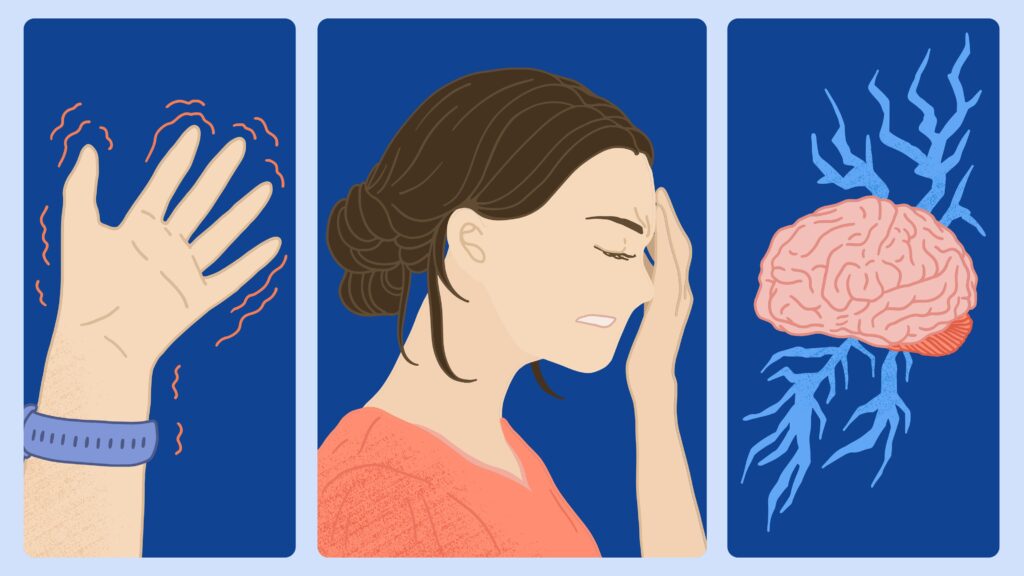
Pain feels like a simple message from the body. If your elbow hurts, there must be something wrong with your elbow. If your back is painfully stiff, you need some work done on your back. But psychologist Rachel Zoffness says our minds play a much larger role in our experience of pain than many of us realize. This week, we look at what’s really happening when we experience pain, and how a better understanding of this process can open up new possibilities for treatment and healing.
In our companion conversation for Hidden Brain+ subscribers, Rachel Zoffness goes deeper into techniques that can help to reduce our brains’ sensitivity to pain. You can hear that episode, which is called “Plastic Brain, Changeable Brain,” with a free seven-day trial to Hidden Brain+. Go to support.hiddenbrain.org or apple.co/hiddenbrain to access your trial subscription.
For more Hidden Brain ideas and insights, be sure to check out our new YouTube channel! And don’t forget to subscribe so you don’t miss any of our upcoming videos.
Episode illustration by Allison Saeng for Unsplash+
Transcript
The transcript below may be for an earlier version of this episode. Our transcripts are provided by various partners and may contain errors or deviate slightly from the audio.
Shankar Vedantam: This is Hidden Brain, I'm Shankar Vedantam. It happens in an instant. You move too fast, and you feel a wrench in your back. That first sharp pain is followed by a persistent ache, bothersome enough to send you to the doctor. A scan reveals a problem, a specialist recommends surgery. You go on to the knife, trusting that once the damaged tissue is repaired, the pain will disappear. The story makes intuitive sense. Diagnose the problem, fix the bone or ligament or tendon that is not working properly, and you'll make the pain go away. But for many of us, that's not how pain unfolds. Aches persist, even when scans look normal, or they vanish without any medical intervention. Treatments that promise relief fail to deliver. We also notice something puzzling. The pain we feel changes with other things happening in our lives. When we're feeling calm or absorbed in something else, the pain subsides. When we feel isolated or sad, the pain gets worse. Today on the show, and in a companion episode on Hidden Brain Plus, we examine why our culture gets so many things wrong when it comes to understanding the true nature of pain. What's really happening when we experience pain, and how to address it? This week, on Hidden Brain. Pain feels like a simple message from the body. If your elbow hurts, there must be something wrong with your elbow. If your back is painfully stiff, you need some work done on your back. The brain in this model is an observer. It registers signals of pain sent in by nerves from the far reaches of the body. But is that really all there is to it? At the University of California, San Francisco, psychologist Rachel Zoffness studies the nature of pain. She has found that our minds play a much larger role in our experience of pain than many of us realize. And they also play a much larger role in how we need to deal with pain. Rachel Zoffness, welcome to Hidden Brain. Rachel Zoffness: One of my favorite ever podcasts. I'm so honored to be here. Shankar Vedantam: Rachel, as you began your own research training, you were taught a one-dimensional biomedical model of pain. Can you describe that model for me? Rachel Zoffness: Absolutely. The biomedical model is an antiquated way of looking at disease and pain that focuses primarily, if not exclusively, on anatomy and physiology and bones and body parts. And what that means in the biomedical frame of things is that when we talk about treating pain, we also talk primarily, if not exclusively, about biomedical solutions. And that takes the form of pills and procedures. So here's what I observe as a clinician and pain researcher. What I observe is that if you have chronic knee pain, you will be sent to 762 knee specialists, but we never talk about your brain at all. Shankar Vedantam: So early on in your own training, Rachel, you encountered a pair of clinical cases documented in the medical literature, which got you thinking about pain in a different way. One was about a 29-year-old construction worker who got injured. Can you set up the scene for me and describe what happened to this worker? Rachel Zoffness: I love these two stories, and I call them a tale of two nails, because who doesn't like rhymes? So, yes, the first story, the first tale of nails, is a construction worker who was working on a job site when he jumped off a plank straight onto a 7-inch nail, and that nail drove through his boot, clear through to the other side. Shankar Vedantam: Oh my God. Rachel Zoffness: Yes. Shankar Vedantam: So the pain must have just been excruciating. Rachel Zoffness: It was excruciating, and his colleagues rushed him off to the emergency department, and he was sedated with a lot of good drugs, like, you know, fentanyl and other opioids. And when the good doctors removed his boot, they discovered that a miracle had occurred. The nail had passed between the space between his toes. There was no puncture wound. There was no blood, and there was no tissue damage. Shankar Vedantam: Well, but why was he in such excruciating pain? Rachel Zoffness: It makes no sense, right? So, here's what pain science tells us, which is so important and fascinating about the science of pain. Our brain is our body's danger detector. That's our brain's job, is to save our lives. And pain is our body's warning system, it's our danger detection system. So, our brain, including this construction worker's brain, used all available information to decide whether or not to make pain and how much. And that included knowledge of his dangerous work environment, it included memories of past pain experiences, which, by the way, are stored in our hippocampus. It used data from his five senses, including this visual of this giant nail sticking out of his boot. It incorporated emotions like panic. And because his brain perceived potential threat of danger, it made pain to protect him. And I'm using those words on purpose. His brain perceived potential danger, and so it made pain to protect him. Shankar Vedantam: I'm also imagining that when he saw the reactions of the people around him, they must have just been horrified to see this nail sticking out of his boot. Shankar Vedantam: And now he's getting feedback from other people, something terrible has happened to me. Rachel Zoffness: Absolutely, that is one of the other factors. The social input, the social data from all the construction workers standing around him, and you can see this giant nail protruding from the top of his boot, like anybody who saw that would be equally as alarmed. Shankar Vedantam: Now, you said that this was a tale of two nails, and the other story that you tell is also about a construction worker, but he was working in Colorado? Rachel Zoffness: That's right. So this construction worker was on a job site in Colorado, and he was using a nail gun. And the nail gun accidentally misfired, and it ricocheted backwards and it clocked him in the jaw. But he saw a nail go shooting across the room and bury in the wall across from him. So he had like a mild toothache and a mild headache, but he continued on with work and life for six days. Shankar Vedantam: So in this case, the nail gun goes off, but he sees the nail embed itself in the wall far away from him. And even though he has a little bit of the recoil that hits his face, he thinks he's basically okay. Rachel Zoffness: That's exactly right. And at the end of six days, six days of eating and sleeping and continuing on with life, he turns to his wife and says, You know, I think I'm going to get this toothache checked out. So he goes to a dentist and the dentist does a scan of his patient's jaw. And much to both men's surprise, they discover a four-inch nail embedded in his face. Shankar Vedantam: Wait, I thought you said the nail was basically flying across the room and embedding itself in the wall. Rachel Zoffness: That's right. So nail guns, I don't use many nail guns, but nail guns can actually release more than one nail at a time. They have like a rapid release. So he saw a nail shoot across the room and somehow, not sure the physics of this, but somehow a second nail came out of the nail gun and it went up through the bottom of his jaw and into his face. And I actually spoke with the surgeon that conducted the surgery and he said, he's the luckiest guy ever. That nail was protruding into his prefrontal cortex. Now, how is it possible that someone can have such significant damage and such little pain? Because this myth, this lie that we are all sold is that pain and damage are one and the same. When you have pain, you go looking for damage. When you have damage, you assume necessarily that you should have pain. But pain or hurt and damage or harm are not the same thing. Hurt and harm are not the same. Shankar Vedantam: I'm really puzzled here, Rachel. What could possibly explain why he had such little pain? Rachel Zoffness: It is so baffling, and here's the answer. It's only baffling until we really understand the true science of pain, and then it makes perfect sense. Here's what happened. We've established that pain is the body's danger alarm, and we've established that the brain is our body's danger detector. So his brain, similar to the first construction worker, his brain also used all available data to decide whether or not to make pain and how much. So his brain also used knowledge of his dangerous work environment, memories of past pain experiences, and visual data. But because he saw that nail shoot across the room and bury in the wall across from him, his brain was under the mistaken impression that the construction worker's body was safe. Credible evidence of danger will amplify the pain alarm. Credible evidence of safety will lower the pain alarm. So because his brain perceived that he was safe, the pain alarm did not sound. Shankar Vedantam: The Biomedical Model of Pain holds that if something hurts, there must be something wrong in the body that needs to be fixed. Sometimes, that model does hold up, but as we've heard, it often falls short. When we come back, how pain really works, in the body and the mind? You're listening to Hidden Brain. I'm Shankar Vedantam. This is Hidden Brain, I'm Shankar Vedantam. Pain is perhaps the most common of human experiences. We all think we understand it. You stub your toe, you feel pain. You accidentally scald yourself in the kitchen, and you feel the burn. It seems straightforward. But this intuitive model of pain turns out to be incomplete. Rachel Zoffness is a pain psychologist at the University of California, San Francisco School of Medicine. Rachel, contrary to the way we usually think about pain, you say that pain is constructed by the brain, not located in the body part that is hurting. Unpack this idea for me. You're saying the brain is not merely perceiving pain, but it's actually constructing it? Rachel Zoffness: You got it. So it's very easy to believe that pain lives exclusively in the body part that hurts, right? So if you have a bad back or you have an aching knee, it's easy to believe that that pain is being constructed exclusively by your back or your knee. But neuroscience tells us that is not true. Pain is ultimately constructed by the brain. And one of the reasons we know this is because of a condition called phantom limb pain. And phantom limb pain occurs when someone loses a limb, an arm or a leg, and they continue to have terrible pain in the missing body part. Now, if you can have terrible leg pain in a leg that is no longer attached to your body, that tells us pretty definitively that pain must be constructed somewhere else and we now know that somewhere else is the brain. Shankar Vedantam: So one of the animating ideas here, Rachel, is something that we have discussed previously on Hidden Brain. The brain was designed by evolution to help us survive, and survival involves understanding what happened to us in the past. But even more, survival is really about deciding what to do next. And you're arguing that pain, like many other signals that the brain gives us, is really about future action rather than merely an accounting of past events. Rachel Zoffness: That's right. So pain's job is to protect us. There are people who do not feel very much pain and they don't live very long. The problem is, there's a very big difference between acute pain, which is three months or fewer, and chronic pain, which is three months or longer. They are designed differently, they work differently in the brain and nervous system, and they are treated differently. And the problem is that we have a chronic pain epidemic. We have 1.9 billion people around the globe currently living with chronic pain, 100 million in the US alone. And because very few people understand pain, we continue to not just misunderstand it, but also to mistreat it. Shankar Vedantam: You talked a second ago about this phenomenon called phantom pain, and this idea was vividly demonstrated by a patient of yours, a young man whom you called Mateo. Can you describe how you first met him, Rachel? Rachel Zoffness: Yes. Mateo was sent to me by a surgeon who called me on the phone, and he told me about a patient who was currently in his office, and no amount of pain medication was working to lower pain volume. And he said, I need your help. Will you see this child? And I learned very quickly that Mateo was 12 years old, and he had found a firework in his parents' garage, and he was very excited. And like a 12-year-old would, he invited his friends to the park so they could detonate the firework and they could all experience the joy of fireworks. And I'm sure the audience is cringing because they know what's coming, but what he told me later, Mateo, was he said, you know, in the cartoons, there's always a really long fuse attached to the firework. And so there's time, you light the fuse and then, you know, Wile E. Coyote or the Road Runner, they have time to run away before it detonates. And that's what he assumed would happen here too. But that's not what happened. Shankar Vedantam: So he takes this firework out into the park. He's with his friends, presumably, they're all standing excitedly around. What happens next, Rachel? Rachel Zoffness: They're standing in a circle, and Matteo is holding the firework in his hands, and they light the fuse. And instead of taking a long time to detonate, instead it exploded right away. And it seared the skin on his face, it blew a hole in his eardrum, it burned his cornea, and it also took off his left hand. Shankar Vedantam: So this is a really terrible accident, Rachel. Matteo must have been rushed to the hospital? Rachel Zoffness: Yeah, he was rushed to the hospital. The doctors had to amputate below the elbow to save him, but they did save him. And the reason they called me was because Matteo was reporting terrible pain in the arm and the hand that they had amputated. So his hand was no longer attached to his body, but he was experiencing that left hand that had been removed, cramping and spasming. And that's not actually very unusual, up to 80% of people who have a phantom limb experience phantom pain. Shankar Vedantam: So I think when some of us hear about phantom pain, we imagine that the nerves that would previously have gone out to Matteo's hand are now cut off at his elbow, and they are signaling to his brain that his hand is still hurting. You're presenting a more complicated view of phantom pain, and that has more to do with the map that the brain has of the body? Rachel Zoffness: That's right. So people who have had a traumatic injury or have had a limb amputated can have stump pain, and stump pain is what it sounds like. It's pain that's being generated by the injury site. And that is a different kind of pain than what we're talking about here. Phantom pain is when what Matteo was experiencing, where his hand had been removed, there was no hand left, but the map of his body that lived in his brain hadn't yet updated with that information. So there's a map of the body that lives in the brain, and it is called the homunculus. And the homunculus is a sensory motor map of the human body. So if I say to you right now, Shankar, sense into your left foot and see if you can feel it in your shoe and feel the sock on your skin and feel your foot on the floor, you can do that. And you can do that in part because of the homunculus that lives in your brain that's giving you data about your entire body. And when you tragically and traumatically lose a limb, it can take some time for the map in your brain to update because without this updating like a computer, the brain is under the impression that that body part is still in danger and it's producing danger messages to get your attention. Shankar Vedantam: I'm wondering how this pain affected this little boy, Rachel. When you saw him, he wasn't just in pain, but he was in psychological distress. Rachel Zoffness: That's absolutely right. When I first met Matteo, he was wearing an oversized sweatshirt to hide his missing arm, and he was shrunken into the couch as if he wanted to disappear. And he came to my office with his father, and his father described how his son had completely changed. He had withdrawn, he was socially isolated, he was not going to school, he was barely eating, and he was sleeping in bed with his parents. Shankar Vedantam: I understand that he also felt guilty about what happened, and wondering whether the harm that he had done to himself and to his friends, whether he should be feeling guilty about it. Rachel Zoffness: He felt terrible. He felt like the entire accident was his fault, and some other children had also gotten hurt during the explosion. >He felt like, yeah, he felt extremely guilty. Shankar Vedantam: Another way that the reality of pain departs from what we've conventionally believed about pain is that the context around pain can change our experience of it. How is this the case, Rachel? Rachel Zoffness: Absolutely. So we talked about how our brain is our body's danger detector, and how it uses all available information to decide whether or not to make pain and how much. And among the things that our brain is using in any given moment is context. What do I mean by context? Context means everything happening around us and inside of us in any given moment. And by that, I mean where we are, who we're with, how we're feeling, even our past memories. And that's why if you stub your toe on the day you get fired from work, it is going to feel completely different than that exact same injury when you're at the beach with friends. And it's also why if you're someone who is interested in spicy sex, if you're with a partner that you trust and love and you get spanked and smacked and bitten, it will feel completely different than those exact same injuries when you are getting mugged. Context always matters to the brain when it's deciding whether or not to make pain and how much. Shankar Vedantam: You know, I remember as a small kid, we had a family doctor whom I really liked. And whenever I was in pain, just being in the presence of this doctor would magically make my pain seem to go away. In some ways, that's what you're talking about here, isn't it? Rachel Zoffness: Absolutely. The context in which pain is delivered matters so much. It's why things like distracting a child with screens will lower the pain alarm. It's why going to a doctor that we trust and like will change the pain experience. Some of us, including me, have had this maddening experience wherein some body part hurts, your tooth or your knee, and you go to the trusted doctor's office, and while you're sitting in the waiting room, the pain seems to disappear. It's maddening in a way because it's just this reminder that the brain is always using all available data in every single moment of our lives. People with chronic pain know that because people with chronic pain will tell me, that their pain will change over the course of an hour, a day, a month. And that's because all of these factors are always coming together to change the pain experience. Shankar Vedantam: Now, I think some people might hear this conversation and say, okay, the pain signals that are coming from the nerve endings in your ankle, that is real pain. The pain signals that are being created within the mind are just in your head. Why is this the wrong way to think about pain, Rachel? Rachel Zoffness: Of course, people would think that, and that makes good sense. So I want to clear this up once and for all. The parts of the brain that make emotions also make pain. Our limbic system, our amygdala, those are critical parts of the pain machinery. And what we actually know about pain is that 100% of the sensory messages from the body filter to our brain's emotion machinery, before they become the thing we call pain, pain is never all in your head. Pain is never purely psychological. Pain is both physical and emotional 100% of the time. Shankar Vedantam: The notion that pain is not simply a signal from the body, but an experience constructed by the brain, opens up a world of possibility for treatment. It implies that pain is not fixed, that it can be influenced by how we think and what we do. That's coming up next. Also, in our companion episode on Hidden Brain Plus, we return to Mateo's story and describe a novel technique that Rachel used to help him rewire his brain. The story also explores the larger question of how we can use the plasticity of the brain to manage pain. If you're already a subscriber, that episode is available to you right now in this podcast feed. It's titled Plastic Brain, Changeable Brain. If you're not yet a subscriber, please go to support.hiddenbrain.org. If you're using an Apple device, please go to apple.co. slash hiddenbrain. You'll instantly have access to all our subscriber-only content, including past episodes. You're listening to Hidden Brain. Shankar Vedantam: I'm Shankar Vedantam. Shankar Vedantam: This is Hidden Brain. I'm Shankar Vedantam. Has this conversation evoked your own experience with pain? If you have a personal story about how you overcame pain that you would be willing to share with the Hidden Brain audience, or a question or comment about this episode, please find a very quiet room and record a voice memo. Two or three minutes is plenty. Then email the file to us at feedback at hiddenbrain.org. Use the subject line pain. Again, that's feedback at hiddenbrain.org. Rachel Zoffness is a psychologist at the University of California San Francisco School of Medicine. She is the author of Tell Me Where It Hurts, The New Science of Pain and How to Heal. Rachel, you make the case that when we think about pain, we shouldn't think about it as a biomedical problem, but as a biopsychosocial phenomenon. What do you mean by this term? Rachel Zoffness: Right. So if listeners remember nothing else from today's podcast, I hope they remember this word, biopsychosocial. And I want to say clearly, this is not my pet invention. I did not come up with this. Neuroscience has known for 65 years that pain is never a purely biomedical phenomenon, something to do just with bones and body parts. Pain is more complex and beautiful and nuanced than that. So if you imagine a Venn diagram with three overlapping circles, we have bio on the top, biological factors that contribute to pain. We've got psychological factors and we've got sociological factors. And pain lives in the messy middle of all the things that make you, you. Shankar Vedantam: I'm wondering if you can spend a minute talking about what's in each of those circles, Rachel. Rachel Zoffness: Yes, so the bio domain of pain is the one we've all heard the most about. It's genetics and tissue damage, system dysfunction. It's also diet, exercise and sleep. And those are all critically important when it comes to the experience of pain. But what I want us to notice is that if we're only focusing on the bio domain of pain, which is what we do in Western medicine, we are literally missing two-thirds of the pain problem. So in the psych domain of pain, we now know negative emotions like stress, anxiety, and depressed mood will amplify the pain alarm, while positive emotions like joy and happiness and relaxation and gratitude will lower the brain's pain alarm. And in the sociological domain of pain, we have social and environmental factors, and that includes socioeconomic status, access to care, race and ethnicity, social support or lack thereof, and our environment, which includes history of abuse and trauma. Because trauma, it turns out, doesn't just live in the brain, it also lives in the body, and trauma and chronic pain are best friends. And what's so fascinating and shocking to me is that we have known this science for many decades, but it hasn't yet found its way to medicine or treatment. Shankar Vedantam: So when it comes to trying to combat pain, given this complex interplay of forces, you see that it's important to address emotional health directly. Now it can seem odd to tell someone who has a back problem to pay attention to their anxiety or their sadness, but you're making the case that our emotional states very much shape the pain that we experience. Rachel Zoffness: That's right, because we know that the parts of the brain that make emotions also make pain. Every emotion we have triggers a physiological cascade of events in the human body that affects all of our systems. So for example, when we get stressed or anxious, we might have a racing heart, maybe our mouth will get dry, our palms will get sweaty. What's crazy to me is that we don't talk about our emotional health when it comes to physical health. Emotions profoundly and constantly change the pain experience. And we all know that we've seen how our bodies feel worse during times of stress and duress. Shankar Vedantam: You also recommend that people who suffer from chronic pain should find ways to strengthen their social connections. How would this help them with their pain? Rachel Zoffness: Right, one of the worst punishments you can give a human being is solitary confinement. What does it say about human beings that one of the worst things you can do to us is isolate us from others? Humans evolved to be social. In fact, social behavior is so critical for our survival that our brains evolved a mechanism to reward us for engaging in it. In the presence of other people, our brains produce feel good brain chemicals like dopamine, which of course is motivation and reward, serotonin, which boosts our mood, and endogenous opioids. When we are with other people, we feel better both emotionally and physically. And when we are isolated, we feel worse physically and emotionally. And there's one more data point I want to share with you. There's been a lot of research conducted on the elderly, and among those who are lonely and isolated and alone, rates of morbidity and mortality are higher, rates of disease and death. And so what that means is, if you are healthy and you're lonely and isolated and alone, you are more likely to get sick. If you are already sick, you are more likely to get sicker, and you are also more likely to die. And there's a number of reasons for this, but one of the reasons that I find so compelling is that when we are chronically lonely and isolated, our bodies produce high levels of cortisol, which is a stress hormone that over time suppresses our immune system, which of course affects morbidity and mortality, and also pain. Social behavior absolutely and profoundly changes our human body, and it has a huge impact on the pain we feel. Shankar Vedantam: You also, in working with patients who are dealing with pain, you help them improve their sleep and diet and daily rhythms. Talk a little bit about the value of doing this, Rachel. Rachel Zoffness: That's right. So just as there's a recipe for brownies, there is always a recipe for pain. And we talked about how pain is biopsychosocial. So in this recipe for a high pain day, there are a number of biological, psychological, and sociological ingredients that are going into pain amplification. So I'm going to give you my high pain recipe. For example, if I'm sitting and staring at the computer for too many hours, and I've had a poor night's sleep, and I'm eating a crap diet, and I'm not protecting time to move my body and exercise, and I'm socially isolated, I know that combined with some other ingredients, that is going to construct what I like to call a high pain recipe. Now, the really cool thing about constructing pain recipes with my patients is that as soon as I'm able to help them map out a high pain recipe, we are then able to construct a low pain recipe. And a low pain recipe is often just the opposite. So I mentioned poor sleep. Poor sleep for me is a predictor of high pain. So I know that if I want to change my pain recipe, I need to start implementing a sleep hygiene protocol. For example, for myself, I know that I need to set a sleep time and a wake time. I know that I need to stop doom scrolling before bed and put my phone away a couple of hours before getting into bed. I know that if I can't sleep and I'm getting anxious and restless, I need to get out of bed and go somewhere else and not lay in bed feeling restless and anxious. So for every ingredient in the high pain recipe, there is a matching corresponding ingredient that we have the power and agency to change to create what I call a low pain recipe. And everyone has one and they're unique to us. So that's something that everyone has the power to do, is to look at the ingredients in their high pain recipe and find some strategies that help us achieve a low pain recipe. Shankar Vedantam: One thing that some people with chronic pain experience, Rachel, is a voice that basically says to them, I'm broken, I'll never get better, my body hates me, I'm a burden on my friends and family. Talk about the role that this voice plays in our experience of pain. Rachel Zoffness: Yeah. So that's quite normal and expected when we have pain. And I call this voice pain voice. And the reason I name it pain voice is because I think it's so important for us to recognize that it's a voice of negative predictions, worries and fears and worst-case scenarios that commonly accompanies pain, but it isn't us. That's just pain voice and its job is to protect you. And to protect you, sometimes it gives us these negative predictions. But here's the thing about thoughts. Thoughts don't just live in the space between our ears. Thoughts are physiological, neurobiological events that trigger a cascade of events in the human body that affects all of our systems, our neurotransmitters, our hormones, our immune system, circulation, digestion, our musculoskeletal system, like all the way down the line. So every thought we think has a profound impact on the human body, which of course affects the pain we feel. And neuroscience has shown us that negative thoughts actually amplify pain because of this neurobiological cascade I just mentioned. And neuroscience also tells us that the opposite is also true. In fact, 70% of studies on pain and optimism show a real connection between hopeful thoughts and reductions in pain intensity, pain frequency and even disability. Shankar Vedantam: I'm wondering if people have this pain voice inside their heads, how do you recommend they change it? Rachel Zoffness: One of my favorite strategies for dealing with pain voice is this strategy called using detective questions. And by that, I mean, pain voice likes to speak in hyperbole and negative predictions that actually aren't rooted in reality. And the only way sometimes for us to see for sure that the thought is just a thought and not a fact is to test its veracity. And by testing its veracity, I mean, I'm going to sit down and ask those thoughts some questions. And I call these detective questions because I want to investigate whether the thought is true or whether it's a trap. Because chances are high, if it's pain voice, it's trapping me into being scared and immobilized in order to protect me. Again, pain voice isn't mean, it's just trying to protect you and keep you immobilized until you get the help you need. So, one detective question that I like to recommend is, is this thought a fact? And by fact, I mean unquestionably, undeniably, absolutely true. So the thought you offered, I'm broken, I'll never get better. Is that a fact? And I think anyone, once they're critically looking at that thought, can tell you, that is not a fact. It is not a fact that I will never ever get better. That can't possibly be true, because I don't have the ability to predict the future. Shankar Vedantam: A reminder that if you have a personal story you'd be willing to share with the Hidden Brain audience, or a question or comment about this episode, please find a very quiet room and record a voice memo on your phone. Two or three minutes is plenty. We are especially interested in ways that you have learned to manage your pain, and techniques that you found helpful that could be helpful to others. Email the recording to us at feedback at hiddenbrain.org. Use the subject line, pain. Again, that's feedback at hiddenbrain.org. As we've seen, the mind plays an important role in the treatment of pain. This was brought home very clearly to Rachel when one of her patients named Kai was unwittingly enrolled in an experiment by his own sister. Rachel Zoffness: Kai was a patient I had, I believe he was in his 40s, and he was wheeled into my office by his sister, Aiko. He had a condition called Fabry disease and he wasn't able to go to work. And his pain was so terrible that he couldn't wear shoes or even cut his toenails. So we had these extremely long toenails that looked like talons and it really just stood out to me because he wasn't even able to touch his own feet. As I got to know Aiko and Kai, we talked about the signs of pain, we talked about the role of the brain, we started putting together his pain recipe. And as we were on this journey together, Kai was prescribed by a trusted provider, CBD gummies. And so Kai went home and his sister gave him one of these CBD gummies. And if I remember correctly, it was cherry flavored and bear shaped. And he took the CBD gummy and it made him very sleepy and he wheeled himself into the living room and he laid down on the couch and he fell asleep. And when he woke up, his pain was gone and he couldn't believe it. And he stood up and he even touched his feet and he put on his shoes and he called his sister into the room. They were both astonished. And when he woke up the next morning, the pain had returned. So the next day, they went through the same routine. She gave him a CBD gummy. He wheeled himself into the living room, laid down on the couch, fell asleep. When he woke up, the pain was gone. Now, his sister wondered if maybe there was more to it than just that. She wondered if his predictions and his expectations also had something to do with it. So she conducted an experiment without my knowledge. I did not know she was doing this, but she went to the store, she bought regular cherry gummy bears, and she swapped out his CBD gummies for these regular cherry gummies. The next day, Kai came in to get his medication, she handed him a regular cherry gummy bear, and here's what happened. He got sleepy and tired, he wheeled himself into the living room, he laid down on the couch, he fell asleep, and when he woke up, his pain was gone. Aiko was astonished, and of course Kai didn't even know that his gummies had been swapped out. Aiko did this every day for a week. She gave him a placebo gummy, Kai's pain disappeared, and the next day when the placebo effect wore off, she would give him a new regular cherry gummy bear. And after a week, she told me she felt so guilty that she told Kai what she had done and expected him to be enraged. But instead, he felt hopeful and happy and relieved because what it told him was that there was something happening with his pain that was more than just a medication and that there maybe were some things that he could do to change his pain beyond just the gummy bears. Shankar Vedantam: And of course, we talked earlier about the biopsychosocial model. If your psychological prediction is, in fact, you are going to get better because you've taken a medication that's going to help you, it's not surprising that that's actually going to change where you end up on that Venn diagram, that biopsychosocial Venn diagram. Rachel Zoffness: That's exactly right, because thoughts and predictions trigger a biological cascade of events in the human body that affects systems throughout the human body, including our neurotransmitters, our hormones, our musculoskeletal system, and thoughts and predictions can actually physiologically lower the brain's pain alarm. Shankar Vedantam: You had a patient, a teenager whom you called Sam, who had experienced a lot of pain without a clear diagnosis. He'd been to lots and lots of providers. He had started to withdraw from studies and from sports. When he came to you, Rachel, describe his affect and how you started to work with him. Rachel Zoffness: When I first met Sam, he was 17 years old. He had been in bed for four years. He had long unwashed hair, he was pasty and pale, and he was rocking himself back and forth on my couch with the pain. So he had been diagnosed with chronic migraine and diffuse amplified body pain of unknown etiology, meaning he had seen a bazillion doctors, something like 14 of them, and he had been on 40 medications, but nothing had helped and no one really understood why Sam was in so much pain. So by training, I've been studying pain neuroscience, pain biology, and pain psychology for 35 years, but I think of myself really as a pain detective, because it's my job to look at all of the biopsychosocial factors that are going into creating and amplifying the pain to see what I can do to help turn pain volume down. So as I conducted an assessment of Sam, I quickly learned that Sam had been living with crippling social anxiety and suicidality for many years without relief or adequate treatment. He was also sleeping poorly. He was up playing video games until four in the morning. He was on what I like to call a white food diet, which is not uncommon in America, where he was eating pizza, pasta, chips, and cereal, but he just didn't like fruits and vegetables, and so he wasn't eating them. And what became clear to me was that if I wanted to help Sam, I needed to help him target all of the ingredients in his recipe. Medications alone just weren't going to cut it, and of course they hadn't. So I met with Sam and his parents, and we introduced him to fruits and vegetables, one per meal. We put Sam on a sleep hygiene protocol to help him improve his sleep, and I put him also on a pacing protocol. And we said before that pacing for pain is much like pacing for a marathon. So what that meant for Sam, who had been bed bound for four years, and had been completely socially isolated and depressed and alone, was that week one, he got out of bed, and he stood outside on the porch in the sun. That was step one of his pacing protocol. Week two, he walked to the corner mailbox, and he texted just one friend. Week three, he walked around the block, and he invited a friend over to watch a movie. And you'll notice, we're targeting sleep, we're targeting social behavior, we're targeting movement, we're targeting nutrition, we're targeting his mood and his physical health. All of the things we're targeting. And Sam also got a tutor and he started catching up in school. And here's what happened. As Sam's social and emotional and physical health started to improve, pain volume started to go down. And Sam eventually went back to high school. This is my favorite detail of the story. When he went back to high school, he got asked to prom, not by one girl, but by two. And he said yes to both. And when he finally graduated high school, Sam walked on stage and he told us all, you know, if you had told me four years ago, I'd be graduating high school, I never would have believed you. And, and, you know, he went off to college and he went off to work and has a job and has a life. And what's so critically important to me about this story is that Sam can be anyone of any age and the critical detail here is that everyone has a pain recipe and there are many ingredients in that pain recipe. And we have the power to change those ingredients because ultimately, pain is a whole person problem that requires a whole person solution. Shankar Vedantam: Rachel Zoffness is a psychologist at the University of California San Francisco School of Medicine. She's the author of Tell Me Where It Hurts, The New Science of Pain and How to Heal. Rachel, thank you so much for joining me today on Hidden Brain. Rachel Zoffness: This has been a singular and wonderful experience. Thank you for having me. Shankar Vedantam: In our companion episode on Hidden Brain+, we return to the story of the little boy who experienced phantom pain after the lower part of his arm was amputated. Rachel describes a novel technique that she used to help Matteo rewire his brain. The story also explores the larger question of how we can use the plasticity of the brain to manage pain. If you're already a subscriber, that episode is available to you right now in this podcast feed. It's titled Plastic Brain, Changeable Brain. If you're not yet a subscriber, please go to support.hiddenbrain.org. If you're using an Apple device, please go to apple.co. slash hiddenbrain. You'll instantly have access to all our subscriber-only content, including past episodes. Hidden Brain is produced by Hidden Brain Media. Our audio production team includes Annie Murphy Paul, Kristen Wong, Laura Kwerel, Ryan Katz, Autumn Barnes, Andrew Chadwick, and Nick Woodbury. Tara Boyle is our executive producer. I'm Hidden Brain's executive editor. If you like this episode, please think of a friend who might like it and share this episode with them. If they are new to Hidden Brain, they may also discover other episodes that are of interest. I'm Shankar Vedantam. See you soon.Podcast:
Subscribe to the Hidden Brain Podcast on your favorite podcast player so you never miss an episode.





Newsletter:
Go behind the scenes, see what Shankar is reading and find more useful resources and links.