
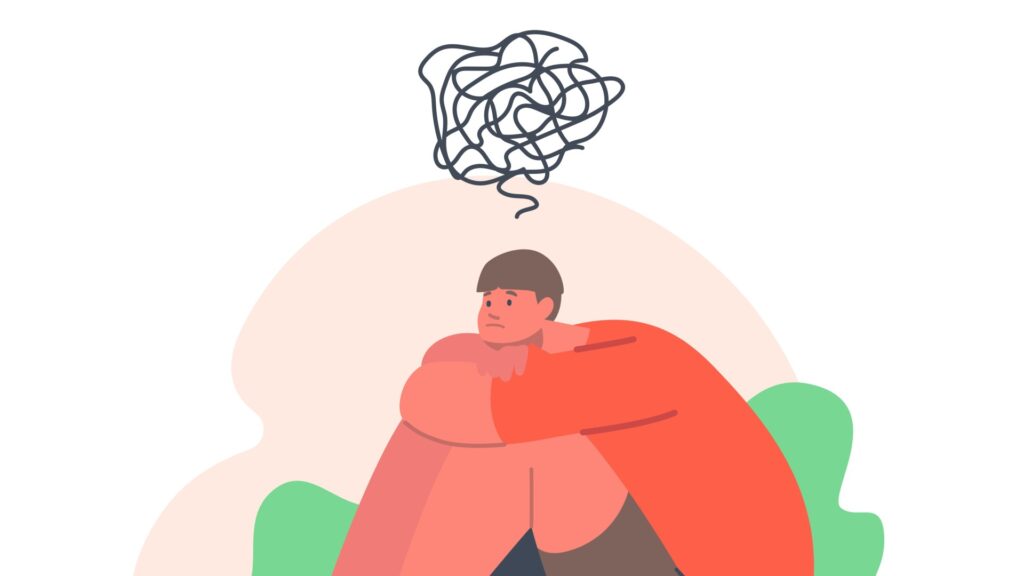
The start of a new year is a natural moment to set goals for ourselves. But doing so can also be a little daunting. Today, we kick off a series designed to help you understand and grapple with the mental obstacles that can keep you from charting a new path. We talk with psychologist Greg Walton, who studies how our minds get trapped in negative thought spirals — and how we can begin to break free. Then, in the latest installment of our segment “Your Questions Answered,” psychologist and neuroscientist Abigail Marsh answers listener questions about the minds of extremely kind and generous people.
If you enjoyed our conversation with Greg Walton, don’t miss our companion conversation about the emotional tools we can use to help someone who’s spiraling. You can listen to that episode with a free seven-day trial to our podcast subscription, Hidden Brain+. To sign up, go to support.hiddenbrain.org. Or if you’re using an Apple device, you can go to apple.co/hiddenbrain. Thanks, and Happy New Year!
Additional Resources
Book:
Ordinary Magic: The Science of How We Can Achieve Big Change with Small Acts, by Gregory M. Walton, 2025.
Research:
Who Gets to Belong in College? An Empirical Review of How Institutions Can Assess and Expand Opportunities for Belonging on Campus, by Kathryn M. Kroeper, Maithreyi Gopalan, Katherine T. U. Emerson, and Gregory M. Walton, Educational Psychology Review, 2025.
The Strengths of People in Low-SES Positions: An Identity-Reframing Intervention Improves Low-SES Students’ Achievement Over One Semester, by Christina A. Bauer, Gregory Walton, Veronika Job, and Nicole Stephens, Social Psychological and Personality Science, 2024.
Identity-Reframing Interventions: How to Effectively Highlight Individuals’ Background-Specific Strengths, by Christina A. Bauer and Gregory Walton, Social and Personality Psychology Compass, 2024.
The Power of Small Acts of Inclusion, by Gregg Muragishi, Lauren Aguilar, Priyanka Carr and Greg Walton, Harvard Business Review, 2024.
When Rejection Stings: How Self-Esteem Constrains Relationship-Enhancement Processes, by Sandra L Murray et al., Journal of Personality and Social Psychology, 2002.
Episode illustration by Getty Images for Unsplash+
Transcript
The transcript below may be for an earlier version of this episode. Our transcripts are provided by various partners and may contain errors or deviate slightly from the audio.
Shankar Vedantam: This is Hidden Brain, I'm Shankar Vedantam. In 1971, a 17-year-old girl won the Miss Black Tennessee Beauty Pageant. It set in motion a chain of events that would transform not just her life, but the lives of millions of other people. Born into poverty to a teenage mother in rural Mississippi, Oprah Winfrey had endured a difficult childhood. She bounced between relatives, experienced abuse and left home at 13. The pageant became the first domino in a series of extraordinary events. Her win caught the attention of WVOL, a local radio station. It offered her a part-time news position. At 19, Oprah became Nashville's first female African American news anchor. She then moved to Baltimore for television news and eventually to Chicago, where she transformed a struggling morning show into the Oprah Winfrey Show. Oprah Winfrey Clip: I'm Oprah Winfrey and that's what we're talking about today. Shankar Vedantam: Then came a production company, a magazine, a book club, and eventually her own television network. Oprah Winfrey became a billionaire, a household name. For millions of people, she was the American dream made real. Can you see how each opportunity created momentum for the next? How each win opened doors that were previously closed? As the saying goes, nothing succeeds like success. But if good things can build on one another, if success can lead to more success, can the same thing happen the other way around? Can setback lead to setback, failure to failure? Can one door that is close to you turn into an endless series of obstacles? Perhaps, you know people who have experienced such downward spirals. Perhaps, you have experienced this yourself. The cost of downward spirals are felt most acutely by the people who experience them. But all of us are made poorer by them. How many operas do we not have today because some domino in the distant past took a spill in the wrong direction? This week on Hidden Brain and in a companion story on Hidden Brain Plus, we explore the psychology of downward spirals and how our minds can set us up for failure or success. It's the kickoff to a month long series about the mental obstacles we face when we try to achieve a goal or start a new chapter in our lives. Perhaps, you have a New Year's resolution for yourself. Maybe you're struggling to keep your momentum on a work or personal project. Whatever your goal, we're going to examine why we derail our best laid plans and how to stay on track. Support for Hidden Brain comes from Whole Foods Market. Whether you're hosting the big dinner, or don't want to show up empty handed, Whole Foods Market is your holiday headquarters. Get everything you need from delectable food to host gifts they love. Look for sales on main course proteins with no antibiotics ever. Plus look for cookie gift boxes in the bakery. Shop for everything you need at Whole Foods Market, your holiday headquarters. Support for Hidden Brain comes from AT&T. AT&T believes hearing a voice can change everything. Shankar Vedantam: When it rains, it pours. One bad thing is often followed by another. Your cat jumps up on the breakfast table and spills your coffee on your lap. In a bad mood as you drive to work, you end up having a fender bender. Stressed out and distracted, you now tune out during an important meeting, which hurts your chances of getting that big promotion. The world seems to be conspiring against you. Sometimes these downward spirals are just a bad day, but other times they can grow bigger, much bigger. You can find yourself in a relationship that grows toxic or a job you hate. Addiction, depression and financial trouble can follow. At Stanford University, Greg Walton studies the mental factors that set us up for failure and wise psychological interventions that can turn us toward success. Greg Walton, welcome to Hidden Brain. Greg Walton: Thank you so much for having me. Shankar Vedantam: Greg, I want to start by talking about self-fulfilling prophecies. When you were a kid growing up in Michigan, you and your family would often go canoeing. Now I understand that you spent quite a bit of time in boats and you were a fairly skilled paddler. Greg Walton: Yes, it was like one of the big family activities we did. Almost every summer, we would go on a canoe trip, often in far northern Ontario and big rivers. It was something that I loved to do and I'd love to do as part of our family. Shankar Vedantam: I understand that you once took a canoe trip with your father on the Sturgeon River. I don't think I have ever visited. What is this river like? Greg Walton: Yeah, so this is a story that he loves to tell because I am the one who am the victim of it. This is a small river in the northern part of the lower peninsula of Michigan. It's a fast and windy river, a small, quick river. The outfitter tells you when you are renting the canoes from them that most people flip the boat on the river at one time or another. The river is quick. It turns quickly. There are lots of overhanging branches, lots of overhanging lots of trees that have fallen in the river that you have to dodge. The water goes through those rushes very fast. If you hit them in the wrong way, the boat can turn sideways and you can fill the boat. And there you are having an unplanned swim. Shankar Vedantam: So the outfitter who was walking you through this described something called sweepers. I'm not much of a paddler myself. Can you describe what a sweeper is, Greg? Greg Walton: Yeah. So if you imagine a river that's making a turn and the water is rushing through the outside part of that turn and then a tree is overhanging that outside part of the turn, so the branches come all the way down to the water, the river can sweep through very quickly but the boat can't, the boat will get caught in the branches. So if you're in the main flow of the current and you're in that outside flow and you hit the tree, then you are held up but the water keeps going and that's a recipe for disaster. Shankar Vedantam: So the outfitter has basically warned you about the river, it has these sharp turns with these sweepers and your family is setting out. Shankar Vedantam: I understand that you're in the boat with your dad and did you exchange any notes before you set out on this journey? Greg Walton: Yeah, our goal is to avoid the sweepers, right? So when we see the current sweeping around to the left side and these branches hanging down, we're going to stay to the inside of those curves so that we don't get caught in the branches. And as we went down the river, we saw boat after boat caught in those branches. Shankar Vedantam: And what happened? Did you get caught as well? Greg Walton: We missed every sweeper. I felt very proud of myself. I was 10 years old, and I felt like I was an accomplished canoeist. Shankar Vedantam: So you're sitting at the front of the boat. Your dad is sitting at the back. You've made it through most of these sweepers. You must be feeling pretty triumphant at this point. Greg Walton: I'm feeling great. And then we get to this little normal curve with no branches in sight, not even especially fast water. And the boat is moving to the right, and I feel a little jostle to the left. And the words of the outfitter came to my mind. Eighty percent of people take an unplanned swim. And so I kind of put those two parts together, and I was like, we're going down. I'm getting out of the way. So I decided to jump out of the boat to get out of the way as the boat capsized. And of course, that's what flipped the boat. Shankar Vedantam: Wait, so now you're in the water. Did your dad go in the water as well? Greg Walton: I'm in the water. My dad's in the water. Our stuff is all floating downstream. My dad is sputtering at me, very upset. We end up losing like a life jacket and a spare paddle. We spend 45 minutes retrieving our stuff and drying out. Everybody's laughing at me. Shankar Vedantam: Years later, after Greg became a psychologist, it became clear to him what happened that day. The problem was not the river. The problem was inside his own head. Greg Walton: So I had the idea planted in my mind that things were going to go wrong. And then I was looking out for the moment when they might go wrong. And as soon as I saw that moment, I was like, is going wrong? And I acted. And of course, the acting is what made it go wrong. Shankar Vedantam: So this reminds me of that classic study by the great psychologist Daniel Wegener, called the White Bear Experiment. Describe what this study was, Greg. Greg Walton: Yeah, what Professor Wegener did was ask people not to think about a white bear, and then write down their thoughts in a stream of consciousness, like what they're thinking about for several minutes. And he finds that almost everybody references a white bear, even though that's the one thing that they're specifically not supposed to be thinking about, that the act of suppressing it, trying to not think about it, that actually calls it to mind. Shankar Vedantam: I mean, even as we're talking right now, I feel like I can see a ton of white bears walking across my mindscape right now. Greg Walton: Exactly, right? Don't think about it. And then there it is. You can't help but think about it. Shankar Vedantam: So sometimes the boat flips because the current is too strong or we're not skilled enough, but sometimes our own minds can set us up for failure. Make the connection for me between your story in the boat and the white bear study. Greg Walton: Yeah. So I hear the message that most people flip. And I could be trying to suppress that the whole time. We're not going to flip. We're not going to flip. It's not going to happen to us. We're good. We're better canoeist than these other people. I know the J stroke. My father knows the J stroke. We're not going to flip. But the very act of trying to suppress that thought keeps it active in your mind. It makes it available. It doesn't mean that it's going to get acted upon. But then when the boat moved in a direction I didn't expect, it became a way to understand that movement. What's happening here? Oh, we're about to flip like I was worried we might. And then I take action and response. And so I think often in life, the things that are preoccupying us, the things that we might be trying to suppress, are these negative contingencies. The relationship that doesn't go the way that you want, the test that doesn't go the way that you want, the failure that might happen. Shankar Vedantam: So in some ways, what you're saying is that as we have these worries in our heads, our minds are preoccupied with these worries, but then we also become vulnerable to seeing evidence that the worry might actually be real when we look at evidence that might or might not actually be real. Greg Walton: Yeah, so it's like the worry is a kind of hypothesis, a kind of fearful hypothesis about how the world might be. It might be like this. Maybe this person doesn't really love me. Maybe I'm not good at this. Maybe I don't belong here. And those are leading questions that we use to interrogate our experience, that we read the world through the lens of. And I think it happens to all of us. I think it happens all the time. And I think it's partly a consequence of our kind of default response of trying to suppress these thoughts and not to contend with them in an honest way. Shankar Vedantam: When we come back, habits of mind that can set us on the path of downward spirals and how we can pull ourselves out. You're listening to Hidden Brain. I'm Shankar Vedantam. Shankar Vedantam: This is Hidden Brain, I'm Shankar Vedantam. Sometimes when we expect the worst, the worst is exactly what we get. We tell ourselves a story, I'm not good enough, I'm not smart enough, and then we go looking for evidence to back up our beliefs. Sure enough, we find what we are looking for. But self-fulfilling prophecies are not the only reason we get in our own way. At Stanford University, psychologist Greg Walton says a number of factors can lead to downward spirals. Greg, the psychologist Sandra Murray once ran a study that looked at how couples can get into relationship trouble. The study had a very clever design. Can you describe it for me? Greg Walton: I can. Yeah, this is one of my favorite all-time studies. So Sandra Murray brought couples into a lab. These are dating couples. And she gave them a situation where she has them at separate desks in the same room and she asks them each to write about all of the things about their partner that they dislike. And in the first condition, both people do this. Both people write for 30 seconds or a minute or a minute and a half. Both finish and then they're all done and everybody's okay. But in the second condition, one member of the couple is going through that task. They're writing all the things that they don't like about their partner, but their partner is asked unbeknownst to the first person to do something different. The partner is asked to list all of the objects that are in their apartment or house. So imagine you're the first person. You jot down a couple of annoyances you have with your partner, but your partner is writing on and on as if one thought automatically leads to the next and you can't stop like this, that. Oh my God, it's like never gonna end. Like what are they writing? Shankar Vedantam: So of course, because they're listing all the objects in their house, that list is gonna go on much, much longer than the first person's list, which is just describing the things that they dislike. Greg Walton: It's infinite, right? Greg Walton: There's an infinite number of things, it seems your partner has a problem with you about. Shankar Vedantam: What was the effect on the couples of doing this study, Greg? Greg Walton: So what Murray was interested in was how self-esteem functions in relationships. And so self-esteem is like, how much do you like yourself? How good of a person do you think you are? How worthy do you think you are? And lots of research shows that when people have lower self-esteem, they can wonder whether they're truly admirable, whether their partner could truly respect them, truly love them. And so they have a kind of uncertainty about their partner's regard. And what Murray finds is that for people who have low self-esteem, who go through this situation, it triggers them in a variety of ways. And they end up responding by kind of derogating their partner. They feel less close to them and they start to distance themselves from the partner. It's the start of a kind of downward relationship spiral. Shankar Vedantam: Hmm. Shankar Vedantam: So in other words, if you and I were a couple, and I see you writing endlessly about me, and I think you're writing about all the reasons that you dislike me, you're saying that if I have low self-esteem, I now react negatively towards you? I start to derogate you and think less of you? Greg Walton: Yeah. It's a self-defensive mechanism. You're trying to protect yourself by derogating this partner who seems to be derogating you. Shankar Vedantam: So, low self-esteem can lead us to come to conclusions about how others perceive us, and this can have a negative effect on the relationship itself. I'm curious how this shows up in other domains. You've studied a concept called belonging uncertainty. What is belonging uncertainty, Greg? Greg Walton: Yeah, belonging uncertainty is a persistent worry or unsettledness about your belonging in an important space, like a school space or a workspace. And all of us can have this kind of feeling, that all of us can wonder whether we belong in a new school environment, for example, but those worries can be particularly pervasive and profound when we're going into a setting where your group is underrepresented, where it hasn't been welcome in the past, where maybe there's a history of exclusion or discrimination. So for example, if you think about a woman going into a very male dominated profession, if you think about a student of color going into a university setting that hasn't historically welcomed large numbers of students of color, where it seems like the institution is built for and of other people, other kinds of people, then it's very easy to wonder, do I belong here? Could people like me belong here? Shankar Vedantam: If I feel like I'm an outsider in my workplace or my school, does it make it easier for me to jump to conclusion? If a coworker forgets to copy me on an email, for example, is it possible that I then assume that they think I'm not important or not competent or not welcome? Greg Walton: Yeah, so it's a lot like the self-esteem study where there's an ambiguous event. In this case, you don't know what your partner is writing, but they seem to be writing on and on. You know, in a school setting, for example, students might reach out to a professor and maybe they don't get a response from the professor. Maybe they ask a question in class and they don't like how it's received. Maybe they get a poor grade on an early assignment. Maybe they try to join a student group and the student group doesn't want them there. Maybe friends in their dorm go out and don't invite them to that social outing. So there's all sorts of events that happen on a daily basis in a school environment, high school environment, college environment, and also in work environments. And people are reading those events from the perspective of the question, do people like me belong here? And when that question is on the mind, it seems like every event might be further evidence of a negative conclusion. Shankar Vedantam: So it's almost like there's a referendum taking place on that anxiety in your mind, and you say, my coworker didn't copy me on this email, or my friends in my dorm didn't invite me out. That confirms my belief that, in fact, they don't want me here. Greg Walton: Yeah, and ironically, it's particularly powerful in settings that people value, right? So you go to a company, maybe you get a job at a company that you've long admired, that does work, that you think is really important, and you're so honored and proud to be part of that company, but you're also worried about whether you and maybe people like you could belong there. And then these cues kind of build up over time. And every cue you're reading from the perspective of, do I really belong here? Do people like me really belong here? Are we really going to be welcome and able to contribute and valued? And when that's the lens that you're taking on all these daily events, it can feel like the evidence is building. Shankar Vedantam: So in some ways, what we're doing is we are drawing more meaning than we should from a very small amount of information. You've come up with a shorthand for our tendency to overreact to minuscule pieces of information. You call it a tiff bit. What is a tiff bit, Greg, and what's the origin of the phrase? Greg Walton: Yeah, the tiff bit is a tiny fact with a big theory. And my experience on the canoe, where the boat shifted left, that was a tiny fact that I had a big theory about. But the phrase itself, it actually was developed by my brother and me. It came from a story my brother had. He was a musician for most of his 20s. He lived in New York City. And at one point, he started a relationship with a woman. And the relationship seemed to be going very well. It was going on for some months. And then after some time, they break up to his surprise, my brother's surprise. And he didn't see this coming. And so they're having the breakup conversation. So my brother asks her, you know, like, what happened here? Like, why is this going down this way? And she says, do you remember that time we went to Macy's? And my brother remembers an uneventful trip to Macy's. He says, yeah, I remember we went to Macy's. And she said, I had to tell you to tuck your shirt in. I can't be with you. Shankar Vedantam: She breaks up with him because his shirt was not tucked in? Greg Walton: Yeah, she breaks up with him because his shirt was not tucked in. And like the question is, what does that represent for her? Like, what was the meaning that that had for her about who he was, who she was, what their relationship was, what its trajectory was? That was entirely a mystery. But we called that a tiff bit, a tiny fact, a big theory. There's something tiny, but you have a big theory about it. And I don't want to tell that story in a way that makes fun of the woman in the story. I want to tell that story because I want to encourage all of us to attend to the circumstances where you or the people around you seem to be drawing a large meaning from something that's objectively small. When we do that, it's a clue that there's something big under the surface, something big psychological, something big about who you are or who you can be or who another person is. And if you can use that TIF bit to interrogate that and to understand that and to surface that question that's on the table, you're going to be able to function much more effectively. Shankar Vedantam: So, you had an experience in your own life, Greg, where you didn't interrogate your own Tiff bit. Shankar Vedantam: I understand that you were in college, and you came to a rather sweeping conclusion about a famous fast food chain? Greg Walton: Yeah, it wasn't really about the fast food chain so much as its patrons. So I was brought up in Michigan, and I went to college in California at Stanford. And the first year of college and the first quarter at Stanford, somehow an in-and-out truck, a truck from the chain in-and-out showed up on campus. And there was this long line of students, and I assumed that they were all from Southern California, all in line, all eager to get a burger, all very happy. And I look at these people as I'm coming back from class, and I think, I'm not standing in line for a burger, like screw that. And I like march off to the dining hall and I eat my lunch alone. And it took me many years to understand like what it was that was actually going through my mind at that time. But what I came to understand was that I was just profoundly homesick. I was really far from home. It felt like a really different place. These people from Southern California seems so different. I felt excluded from the burger party and I felt excluded from like the social scene. Like maybe I didn't belong with these kinds of people. And I had no real awareness of that at the time. I didn't understand that. I didn't understand that those feelings of belonging and uncertainty were normal, that everybody would experience them, that probably the people from Southern California were having their own version of that experience too. And if I'd had that awareness, I could have been much more effective. I could have gotten in line. I could ask some kid maybe from Irvine, hey, like what's in and out? And I'm sure he would have said, in and out, I love in and out. I went in and out all the time and you got to get it with animal style. And I'd say, what's animal style? And he'd tell me what animal style is. And I would have had a good interaction and I would have felt connected to somebody who was different from me and coming from a different place. And that would have been a sort of belonging supportive experience. But I was unable to do that because I was unaware of my own feelings and I was unaware of how normal those feelings were. So then I just kind of fled. Shankar Vedantam: You know, what's striking here is that as you saw this long line of people at this burger truck, I mean, this is completely innocuous. Obviously, the people standing in line are not trying to exclude you from the school. They're not thinking of you. They're not even aware that you are there. You are reading all of this into the fact that there's this long line of people, and you don't know why there's this long line of people in front of the truck. And as you point out, the tiny fact is magnified because it's tapping into your underlying doubts and insecurities. And so in some ways we are gathering a bunch of these tiny facts and then weave them into these larger stories. So perhaps one day it's, you know, nobody's inviting me to the in-and-out burger truck. The next day, it's something else. Psychologists sometimes call this mental calcification. What does this idea mean, Greg? Greg Walton: Yeah, so it's like when you go from a question to a belief to an almost axiom. So there's a question of belonging, like, am I going to belong here? Will people like me belong here? Will I fit in with these people who are from this different background, to a belief that I don't, to the axiomatic version of that belief. It's not just a mental calcification. It's a calcification in behavior and in patterns of relationships. So if I don't engage with the in-and-out truck, and then I don't have a positive interaction, if you magnify that across all the different spaces, for example, of a college experience, I'm not having positive social interactions with peers. I'm not having positive social interactions with professors. I'm not engaging in the kinds of relationships that ultimately everybody needs to have a good experience in school and to grow in school. If you have a date and the date doesn't go well and you think I'm not lovable, and then you take that mindset to your next date, and the next date goes terrible, you've built a pattern of relationships, a pattern of interactions with other people that gets fixed. Sometimes I think about it with an analogy with pottery. With clay, clay is very malleable. It's very malleable early on. You can shape it this way, you can shape it that way. But when you fire it, it gets fixed, and it gets harder to change. Shankar Vedantam: Why do you think we extrapolate so much from small facts, Greg? Why is it that we have these small things happen to us, and we know in the past, and we know from the lives of the people around us, we know when they exaggerate, we know when our friends or partners, when they basically, they dive off the deep end over something trivial, and we can see that they are overinterpreting some tiny detail. It's much harder for us to see this in ourselves. Why do you think that is? Greg Walton: I mean, there's lots of small facts that we don't overinterpret, but the ones that we do overinterpret are the ones that are probing kind of existential questions for a person, like, can I belong in college? Or can I build, like you fail a math test and you think, I'm dumb at math, I'll never be able to pursue my goal of going to medical school. Like these are existential questions. They define the course of your life, like whether you're gonna be able to be and do who you wanna be and do. And so then that's when we're really attuned, when we're really paying attention. That's when the small things seem to mean a lot. Shankar Vedantam: I remember when I was in middle school or high school, I was doing badly at math. And after a couple of tests where I did badly, the moment I encountered a problem that was difficult on the next math test, my mind said, well, of course, you're not gonna be able to solve this problem. You're not good at math. And in some ways, it's exactly the same pattern that you're just describing. Greg Walton: Yeah, exactly. But it's worth noting that things like fixed mindset ideas about intelligence are literally taught in our culture. Like there's a whole history, a whole sociocultural history of how the idea that there's this quality called intelligence, that it differs very widely between different people, between different groups, that it can be assessed with short tests, that it can be determinative of a person's life course. Like this idea is deeply rooted within Western culture. It's reflected in many institutional practices and many interpersonal practices, like praise, like, oh, you're so smart. And what that does is it sets people up for the kind of thought process that you're describing, where when you encounter some challenge, when you encounter some difficulty, you don't think, oh, like, I haven't got this yet, or maybe I need a different tact into this to understand this, or how else can I approach this? Instead, you think, I just, my mind doesn't work that way. I'm not able to do this. And you check out. Shankar Vedantam: So at one level, you can call this self-sabotage, but in some ways, it's actually sadder than that because the person is not trying to sabotage themselves. They're trying, in fact, to fit in. They want to fit in. They want to do well at math. They want to be a good parent. They want to be healthy. But in some ways, their minds are undermining what they want to do. Greg Walton: Yeah, their minds are undermining what they want to do. And they're doing so often in a very reasonable way that comes from the social context itself. So like in the canoe story, the canoe outfitter said, most people take an unplanned dip. Like that was actually like on their materials, right? You have a student who goes to gifted and talented programs, a student who's praised their whole life that they're so smart. And then they have your experience in math. They get to seventh grade, they get to eighth grade, they get to 12th grade, whatever it is, and they counter something that's challenging. And they think, oh, maybe I don't have that magic ingredient that seems to be necessary for somebody to do this. That idea was taught to people. Or if you want to think about belonging in college, there is a very literal history of racial, ethnic, and social class exclusion from higher education in this country. And so if you're an African American student, you're a Latina student, you're a first-generation college student, or you're a woman going into a male-dominated engineering field, for example, it's very reasonable for you to ask, can people like me belong here? That's literally coming from the context. So the mind is kind of mediating this, and it's kind of producing this consequence. But it's coming from contexts that have a reality to them. Shankar Vedantam: Sometimes a series of negative events is simply a coincidence. Bad luck. But when unpleasant experiences cascade into a whirlpool of negativity, it might be because of unconscious thought patterns that are deeply rooted in how we respond to stress and setback. The good news is, there are ways to interrupt these cycles. When we come back, how to stop a downward spiral before it takes over your life? You're listening to Hidden Brain. I'm Shankar Vedantam. Shankar Vedantam: This is Hidden Brain. I'm Shankar Vedantam. Have you had the experience of being stuck in a downward spiral where one bad thing led to the next? Have you found ways to pull yourself out of a negative spiral? If you have a story, a question, or a comment that you would like to share with the Hidden Brain audience, please record a voice memo on your phone and email it to us at feedback at hiddenbrain.org. Use the subject line failure. Again, that's feedback at hiddenbrain.org. Often in life, we take a wrong turn without realizing it. It's easy to keep walking that path and find ourselves lost in cycles of struggle, self-doubt, and social isolation. Psychologist Greg Walton is the author of Ordinary Magic, the science of how we can achieve big change with small acts. He has spent many years studying how wise interventions at crucial moments can keep us from spiraling downward. Greg, we talked earlier about belonging uncertainty and how it can lead us to jump to negative conclusions that can confirm our fears. One of your studies that has long been a favorite of mine looked at a social belonging intervention among college students who are members of a minority group. Can you describe the challenge that you were trying to address and the intervention that you designed? Greg Walton: Sure. These were African American students attending a predominantly white selective university. What we did was to create an experience for the students where we shared stories from a diversity of older students about the experience of going to college and the worries about belonging that come up in that experience. There were stories from white students and Asian students and African American students and Latino students. There were stories of academic struggles and feeling like you were behind academically. There were stories of being excluded from social events. There were stories of having lots of friends, but then maybe not having the close friends that you really want. And we told the participating students who were in the first year of going to college that they were experts in the transition to college. And we wanted to know their thoughts about why belonging worries are common as students come to college and how they can get better with time. And we wanted to share their advice with future students so that future students could learn from them. And so we gave students the stories, then we gave them lots of space to tell their own story, to describe why these worries about belonging are normal, how they've experienced them, how they've changed over time. And the whole point of all of this was that the goal was that then when students experience those day-to-day challenges, when you got excluded from a social event, when you just had a bad day, when maybe you got a disappointing mark on a test, that you would be able to say, that was unfortunate, that was problematic, I didn't love that, but it doesn't have to mean I don't belong in general in school. It doesn't have to mean that people like me don't belong in general in school. That's the kind of thing that you go through as you go to college. Shankar Vedantam: So in some ways by putting the students in the role of advisors, where they're basically potentially advising future students who come to the college, and they're basically saying, Look, I experienced these setbacks in my first few months of being a freshman in college, but it turned out that they were transient. What you're doing is you're helping the students themselves see that many of these setbacks in fact are transient, that they should not be drawing sweeping conclusions from small amounts of data. Greg Walton: Yeah. When I went to college and I had the in and out experience and I felt homesick, I had no idea that maybe the kid from Irvine too might be worried about their belonging. Like I was just all caught up in my head. The whole process of the transition to college was all about the excitement of going to college. It was all about the opportunities of college. It was all about what an awesome institution it was. There was no allowance for the fact that this is our modern coming of age ritual, that you would have experiences of homesickness, that you would have times that you don't feel so great. You would have times where you don't feel so connected. There was no allowance that that was normal and that was okay and that that could get better over time. It's really important to talk about that and to say that and to say that in lots of different ways and have lots of different people say that so that everybody knows when they're going through their own personal journey of that process, that they know that that's normal and that's part of the process and that they can work through that, that it doesn't become a tiff bit. Shankar Vedantam: What was the effect on the students of this intervention, Greg? Greg Walton: Well, the first thing we did is we looked at their daily diary responses over the next week. We asked them every day what good or bad things happened to them, and we also asked them how much they felt like they belonged in school. What we found is that the intervention didn't change the kinds of daily experiences that students had, but it prevented bad days from having bad meanings. When African-American students had a worse day over the course of a week, with the belonging intervention, they maintained a sense of belonging. Their sense of belonging didn't drop over that period. And then we found that it translated into behavior. They were emailing professors more, going to office hours more, they were actually studying more every night. And then we found that it shifted their grades, so their grades got better over time. We tracked students' grades through the end of college and found that the intervention actually reduced the black-white achievement gap by 50% over that three-year period. And the effect was largest senior year, where there is a reduction of 80%. And then there were lots of downstream outcomes that were important. People were happier, they were healthier, they're going to the doctor less. And there were benefits that emerged even in adult life. At the average age of 27, people reported higher levels of life satisfaction, higher levels of career success. And they reported greater embeddedness in social networks and important relationships, like they were more likely to have mentors. And those mentors had supported those changes over time. That's what we call an upward spiral. So it started with the psychology. How do you make sense of this little daily event? It then transfers into a behavior, okay, that event was bad, but it doesn't mean I don't belong here in general. I'm going to go join a different club. I'm going to go talk to that professor again. And then you have a relationship where you start to have a community and you have a relationship in a community and that becomes really consequential. Shankar Vedantam: So, there's another kind of wise intervention that you call reframing, and there's a story you used to read to your daughter, Lucy, called One Morning in Maine. Tell me the plot of One Morning in Maine and how it relates to this idea of reframing. Greg Walton: Yeah, One Morning in Maine is the classic story from Robert McCloskey. And it's a story of Sal, who's a young child, and she is very eager to go with her father to Buck's Harbor for the day, but she wakes up with a loose tooth. And so she wails to her mama, mama, mama, I have a loose tooth, I have a loose tooth, I'm not going to be able to go to Buck's Harbor with daddy. And her mother then reframes it. She says, oh, when you have a loose tooth, that's when you've become a big girl. And the whole first half of the book, or maybe two thirds of the book, is about Sal kind of playing with that idea. So she thinks, she asks her mother, did you have a loose tooth when you were a little girl? And her mother says, yes. She asks, does baby sisters, Janes, or her tooth, will she have loose teeth too? And her mother says, not for a long time. She's still a baby now. And then she goes to walk on the beach and she wonders whether the birds have loose teeth, whether the seal has loose teeth. And she gets to her father who's digging clams. And she proclaims, I have a loose tooth. I'm becoming a big girl. And her father affirms that interpretation of the event. And then in the sense, the denouement of the story is going to Buck's Harbor and having a great day with her father. Shankar Vedantam: So one morning before school, your daughter Lucy sprained her ankle and she was wailing and didn't want to go to school. I understand that you thought of one morning in Maine as you tried to reframe the situation. Greg Walton: Yeah, I mean, we said everybody gets a sprained ankle and it's not going to be a permanent disability and it's definitely not a reason not to go to school. I told her stories of my own sprained ankles. My wife Lisa told stories of her sprained ankles and we helped her to see that it was normal, it was part of being human and it didn't have to mean anything big. It didn't have to mean that you couldn't engage in the activities and participate in the spaces that you want to participate in. Shankar Vedantam: So in some ways, I think what this is doing is it's asking people to reconsider the possibility that the setbacks that they are experiencing are just setbacks and not catastrophes. Greg Walton: Yeah. So all the time, I think that we have these challenges that we face and when we have a question that's on our mind, those challenges can become catastrophes. So you're struggling with a baby, your baby is colicky and you're wondering, am I going to be a good parent? And it seems like everything you do with this colicky baby is not helpful, maybe makes them cry even more. And it seems to confirm in your mind this fear that you might be a bad parent. And that fear is just as toxic as the thought, like maybe I'm a bad kid is to a kid. Shankar Vedantam: One of the other wise interventions you talk about is the power of surfacing emotions. I understand that you were once visiting a museum in San Jose with your son Oliver, when you had an opportunity to demonstrate this wise intervention. Tell me the story of what happened. Greg Walton: Yeah, it was, the museum is tech interactive, and we had gone through the whole museum, it's a great place, and we had just left, but Oliver was looking at an exhibit just inside the doorway. So the rest of us had just walked outside of the door, and he was still inside looking at this exhibit, and we were waiting for him. And then he burst out, and the tears were streaming down his face, and he was crying, and I picked him up, and I hugged him, and then I thought of this word surfacing. I thought to just try to say what it was that I thought he was feeling. So I said, you were scared you'd be left behind, right? And I could feel him, he nodded, and then I could just feel his body start to relax. It was a way to kind of put the question on the table to say, I see the worry that you have. It's a reasonable worry. And now that we both see it, we can start to let it go. Shankar Vedantam: We talked earlier about how negative spirals can become entrenched in our thinking. We develop fears about ourselves, and then consciously, or maybe unconsciously, seek out evidence that confirms those fears. These spirals then become false stories that we tell ourselves. You found that having a strong personal narrative can serve as a powerful antidote to this pattern. You have a family story involving your grandmother that gives you a sense of identity. What is this story, Greg? Greg Walton: Yeah, my grandmother is someone, this is my father's mother, who is very close with. Her name is Vendla, and in retirement in Tucson, Arizona, she wrote and self-published a couple of books, like memoirs of her life, which was quite extraordinary. And she tells the story of how, when she was 13 years old in 1922, she moved with her family from Minnesota to Arizona in a Model T Ford, how they camped along the way, how they fixed blowouts on the tire, how they homesteaded in Eastern Arizona, how they joined the ranching community there. She went to high school, a boarding school in Los Angeles, and then to college and became a teacher, how she taught in one room schoolhouses in Sedona and elsewhere in Arizona, how she met and fell in love with my grandfather, how they settled in Kansas and fought through the dust storms of the Great Depression. It's stories of strength and agency and grit. It's stories of goodness and community and support and neighborliness. And they're stories that she wrote down in these memoirs. And then they're also stories that she told to me personally. And they're stories that are built into the environment. So in that old homestead land in Arizona, she as a gift and my grandfather received a small amount of land from the old family ranch. And they hand built a cabin out of adobe. It's a cabin with no electricity, no running water. But it's become a place of family retreats and family gatherings. And to me, it represents that strength and that agency and that identity that she has. Shankar Vedantam: Can you talk about how you once had a tough time in college and on Thanksgiving break, you went to visit your grandmother in Tucson. What happened during that holiday, Greg? Greg Walton: Yeah, I mean, college was discombobulating for me.It felt very far from home, very detached.And so there were several times I took the chance to, instead of going all the way home to Michigan, to go to Arizona and spend time with her in her retirement home.I would sleep on her pullout sofa, and she would tell me stories of her experiences when she was my age, stories from when she was a boarding school student and stories from the cabin.And it was a way to reconnect with those identities.I could see her story and I could see her agency as she took on the challenges as she lived through the Great Depression.And as a young person hearing those stories, I couldn't help but hear them from the perspective of the challenges that I faced.And to think, that's how she did it, how could I do it?What's the way that I could do it?How can I be persistent?How can I be kind?How can I reflect those values that are family values?They're not just her values.They're not just my values.They're our values.They're who we are and who we want to be.Here's how she did it.How is it that I could do it?Times have changed.We're not building complicated train ticket arrangements to get from Kansas to the East Coast anymore.We have airplanes.We have different affordances, but what are the values that are guiding us and how can we use those to navigate our lives today? Shankar Vedantam: In addition to the techniques we've discussed today, there's a set of emotional tools that can make a profound difference in helping someone who's spiraling. We talk with Greg about these tools in our companion episode, exclusively on Hidden Brain Plus. If you're a parent or a teacher, or perhaps have a friend or partner caught in a negative thought spiral, you'll definitely want to check it out. If you're already a subscriber to Hidden Brain Plus, that episode is available right now in this podcast feed. It's titled, The Best Version of You. If you're not yet subscribed, please go to support.hiddenbrain.org. If you're using an Apple device, go to apple.co/hiddenbrain. You can get a free 7-day trial in both places. Again, that's support.hiddenbrain.org or apple.co/hiddenbrain. Greg Walton is a psychologist at Stanford University. He's the author of Ordinary Magic, The Science of How We Can Achieve Big Change with Small Acts. Greg, I wanted you to come on the show for many years now. Thank you so much for joining me today on Hidden Brain. Greg Walton: Thank you very much, Shankar. I really appreciate it. It's been a wonderful conversation. Shankar Vedantam: Have you had the experience of being stuck in a downward spiral where one bad thing led to the next? Have you found ways to pull yourself out of a negative spiral? If you have a personal story or a question or comment that you would like to share with the Hidden Brain audience, please record a voice memo on your phone and email it to us at feedback at hiddenbrain.org. Use the subject line failure. Again, that's feedback at hiddenbrain.org. When we come back, your questions answered. Listeners share incredible stories of kindness and researcher Abigail Marsh returns to the show to answer your questions about her work on extreme altruism. You're listening to Hidden Brain. I'm Shankar Vedantam. Shankar Vedantam: This is Hidden Brain, I'm Shankar Vedantam. When I went to journalism school many years ago now, I noticed a certain bias in myself and many of my classmates. We wanted to do hard-hitting work, investigations. Some of us were keen to go to war zones and report from the front lines of conflict. All of us lived in dread of being relegated to so-called puff pieces. A lot of stories fell into the puff piece purgatory. Stories about cute animals, stories about insignificant local events, stories featuring do-gooders and happy endings. It's this last category that will be the focus of the rest of today's show. One thing I've learned since going to journalism school is that do-gooders and happy endings actually make for great stories. People who are extremely kind and generous can in fact be as fascinating as people who are extremely bad. And in a time when so much of the news is disturbing, these stories remind us that kindness and decency are also to be found everywhere. We talked about the heroes who walk amongst us recently with Abigail Marsh. She's a psychologist and neuroscientist at Georgetown University and she studies extreme altruists. If you missed our first conversation with her, you can find it in this podcast feed. It's the episode titled Radical Kindness. Abigail Marsh joins us again for our latest installment of our segment, Your Questions Answered. Abigail Marsh, welcome back to Hidden Brain. Abby Marsh: Thank you so much for having me back. Shankar Vedantam: Abby, one of the groups of extreme altruists that you studied in your research are people who decide to donate a kidney to a stranger.And I'd like to start with a message we received after our episode aired. It comes from listener Lucia Lloyd. Lucia: I really like the things that the episode was saying about how we all want to become more altruistic. And I was particularly affected by the person who said that he believed that God put us on this earth to help people and wanted to do what God wanted in helping other people. And I thought that's what I believe too. And maybe the obvious answer to how can I be more like the people who donate their kidney to a stranger is for me to donate my kidney to a stranger. So I got online and started looking for how I could donate my kidney where I live. And this morning made an appointment with my doctor to get the blood tests that are required to find out my blood type and have a record of that. And so I am already getting started on the process. And it's too soon to know whether I will be accepted to the program, but I hope so. And I wanted to let you know what a positive impact this has had on my life in motivating me, who had never considered donating a kidney before, to go ahead and get started in the donation process. And that I might very easily be ending up to save somebody's life because of your episode. Shankar Vedantam: So that's an incredible story, Abby. I had tears in my eyes when I listened to Lucia's message. I hope she's able to move forward with her donation. And Lucia, please keep us posted if you do. Abby, in your work studying kidney donors, you talked with a woman who was the first known case of what is known as a non-directed donation. What is a non-directed donation, and who was this woman, Abby? Abby Marsh: First of all, I just want to take a moment to thank Lucia for calling in and telling us her story. And I'm incredibly moved and touched to hear about the effect that hearing about kidney donations had on her. Going back to the very first person that we know of, who for sure wanted to donate a kidney to a stranger. Her name was Sunyana Graf, and I should say her name is Sunyana Graf. She's still alive. And she had a very unusual story because, unlike most of the altruistic kidney donors that I have worked with, whose decisions in part were response to finding out about somebody else donating, which I think illustrates the incredible ripple effects that altruism has, she decided to donate having never known anybody who had done it before. She simply knew that there was a need for kidneys, that it was possible to donate to somebody who was unrelated to you. And she was a mom and a Buddhist religious leader at the time, who didn't have a lot of extra time or a lot of extra money to donate. And she thought, you know, I'm somebody who believes helping is an incredibly important part of a good life. This is a way that I can help. And to her great credit, she was very persistent in tracking down a transplant facility that would actually do the transplant. Because at the time, most transplant facilities actually refused to let people donate a kidney to a stranger. Shankar Vedantam: So most people are much less generous towards strangers than they are to our close friends and family. And this is a bias that's known as social discounting. But people who engage in extraordinary real world altruism, like the altruistic kidney donors we've been talking about, show dramatically reduced social discounting. In your research, you explored various explanations for reduced social discounting among these altruists. What explanation did you rule out and which one did you settle on, Abby? Abby Marsh: So in our initial research with altruistic kidney donors, we discovered that they are, unlike most people, very generous to people who they don't know well, who are very different from themselves, who were even strangers. And that makes sense if you're willing to give a kidney to a stranger. It makes sense that you don't discount the welfare of very distant others more. The question is why? And I will say there's a lot we still don't understand about why this happens, but there seem to be a couple of things in mind. First, at the most sort of simple mechanistic level, it's clear that altruistic kidney donors genuinely place more value on the welfare of other people, all other people, and that the value that they place on others' welfare just doesn't drop off as those people become more socially distant from them. Meaning they genuinely believe that what happens to other people matters regardless of who those other people are. It's possible that you could get an effect like that from people getting better and better at overriding the desire to be selfish as the desire to be selfish grows. And so maybe it could be the case that altruistic kidney donors are just very good at overriding the bias to be selfish when it comes to sharing with strangers. But the brain imaging research we did showed no evidence of that at all. When we asked altruistic kidney donors and typical adults to make decisions whether to be selfish or to share with increasingly distant others during fMRI brain scanning, we found no evidence of activation in any of the brain regions that are associated with overcoming internal biases, including the bias to be selfish. Instead, we found patterns of activation in regions like the amygdala and the rostral anterior cingulate cortex that mapped on to the value that the altruists were placing on increasingly distant strangers welfare. Shankar Vedantam: Lucia mentioned in her message to us that she believes that God put us on earth to help other people. This brings us to a question that many people raised. Here's a message we received from listener Bob Dean. Bob Dean: Hello, my name is Father Bob Dean from Holy Family Church in Duxbury, Massachusetts. And I'm calling to ask the question, is there any correlation between religiosity and one's altruism? Shankar Vedantam: What do you think, Abby? Abby Marsh: The relationship between religiosity and altruism is complex. There's no question that most major religious faiths place a lot of value on helping strangers, with the parable of the Good Samaritan potentially being the most obvious example. Jesus makes it extremely clear in his teachings that all of us have the obligation to care for our neighbor, and that neighbor could be anybody, including people from groups that we traditionally don't like or even in conflict with. Many other religions have very similar teachings. Buddhism is one, Judaism, Islam, etc. However, if you look at altruistic behavior across groups of people, you don't see a stronger relationship, as you might expect, between either religiosity and altruism, or a specific religious faith and engaging in altruistic behaviors, with some exceptions. So for example, in a faith like Islam, where there are certain times of year, where giving to others is the tradition during that time period, you absolutely see big increases in giving. But over the course of the year, the differences are not that huge. And to the degree that any community creates a division between those who are like us and those who are not like us, that can actually suppress altruism and generosity. And so unfortunately, there is a tendency in some religious communities, and this applies to many faiths, to make it clear that the people whose outcomes really matter are the people who follow the same beliefs and traditions we do, and people who don't, don't matter. And so that actually suppresses altruism. And so I think there's a lot of sort of competing forces that play into that relationship. My sense is to the degree that your specific religious views are consistent with the idea that there is inherent goodness in people, and that the average person is worth helping, even if you don't know much about them, then that could create a relationship between religiosity and altruism. Shankar Vedantam: One of the messages that you shared with our audience in our initial conversation is that we can all train ourselves to be more altruistic. A listener named Suzy had a question that touches on whether the opposite might also be true. Here's Suzy. Suzy: I was in a situation working as a nurse driving home at 3.30 in the morning and found a woman in the middle of the road, February in Denver, Colorado, freezing outside, naked, beaten and bloody. Pulled over, helped her to the side of the road, wrapped her in a warm sleeping bag I had in my car, waited for the ambulance. I was 27 at the time when that happened. Now I'm 60. And I wonder if your amygdala changes over time. Does the size change? Does experience change that response? I'm not saying I wouldn't do the same thing today. I'm just wondering if life experience, exposure to fear, changes your reaction over time. Shankar Vedantam: So Abby, Suzy referenced the part of the brain known as the amygdala. In our earlier conversation, we talked about your research finding that people who are unusually caring and highly altruistic have larger amygdalas on average, and this might be why they are better able to recognize the distress of other people. What do you think of Susie's question? Can experiencing fear make you more risk averse? Abby Marsh: Interestingly, no. There is really cool data, especially from the pandemic, that states of acute stress seem to make people even more likely to help others, which I think is sort of a really wonderful moral, because I do think compelling works of fiction, like for example, The Lord of the Flies, does paint a picture of people just sort of teetering on the brink of civility. The moment things start to go south and we're all experiencing a lot of fear and stress, we're going to turn on each other. But the reality doesn't seem to bear that out. In fact, there has been a case study of a real Lord of the Flies situation in which a group of boys, I think from Australia, but it was certainly somewhere in the South Pacific, were cast away, lost on a deserted island. And what actually happened in that situation is they formed a little mini civilization. They took care of each other. They collectively found out ways to get food. And they 100 percent supported one another until help came for them. And so that's much more similar to what we see in many other real world situations in which groups are under threat is it seems to create a powerful incentive to band together and support one another. Not universally, right? And I study the full spectrum of what I call the caring continuum from people who are unusually generous on the one end to people who are unusually callous and even psychopathic on the other. So there are always going to be exceptions and people who will take advantage of and exploit people in situations of danger or stress, but that luckily is not the norm. As to Susie's other question about whether people change over time in response to life experiences, absolutely, our life experiences 100 percent change us. In particular, if we've had experiences of stress or fear in which we have been unable to help ourselves, in which we feel less self-efficacy as a result, we've been helpless in those situations. This is speculating based on a number of lines of evidence, but that might cause people to be less likely to want to pitch in when other people are in danger. But in general, when people are in traumatic situations and they pull through, they come out the other side and they actually were able to survive and they were able to withstand more danger and stress than they would have imagined, it increases their sense of self-efficacy and it actually makes them more likely to help others in the future. Shankar Vedantam: When we come back, how culture affects our likelihood to be generous, particularly with regard to strangers. You're listening to Hidden Brain, I'm Shankar Vedantam.Podcast:
Subscribe to the Hidden Brain Podcast on your favorite podcast player so you never miss an episode.





Newsletter:
Go behind the scenes, see what Shankar is reading and find more useful resources and links.